
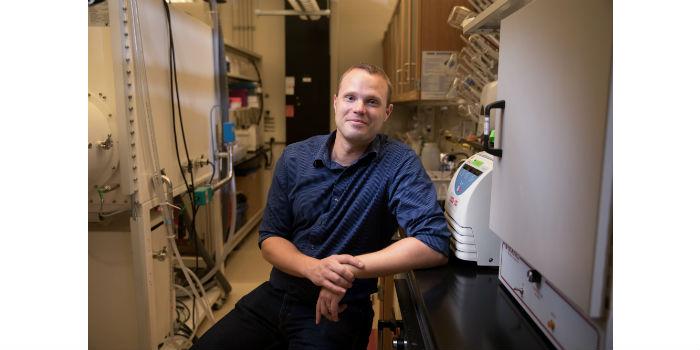
 United States. Bradley Olsen's lab at MIT is exploring the physical properties of new types of polymers, and leveraging those properties to design new materials that could have many useful applications.
"My group is really interested in two things: designing materials to address important challenges and understanding the fundamental science that is necessary for materials design," says Olsen, an associate professor who recently won tenure in MIT's Department of Chemical Engineering.
His lab, which includes between 15 and 20 students and postdocs, pursues these approaches primarily in the field of protein and polymer chemistry, a relatively new discipline involving the incorporation of proteins into polymeric materials. He credits those students with many of the key discoveries that have produced these new materials.
As a graduate student at the University of California, Berkeley, Olsen began working on the synthesis of a special type of polymers known as block copolymers. The materials consist of alternating blocks of two different types of monomers, which are the building blocks for synthetic polymers such as plastics and rubber.
When these monomers are arranged in blocks, they give the total material special properties.
For example, the material may contain two monomers that would normally be separated into layers, in the same way as oil and water. If those two chemically dissimilar molecules are linked together in a block copolymer, they cannot form separate layers. Instead, block copolymers are assembled into special structures, such as spheres, cylinders, or sheets that help minimize interactions between the two chemically different blocks. Such materials are now commonly used in many products, including elastomers, adhesives, and personal care products.
At MIT, Olsen has continued to develop block copolymers for a wide range of applications. In one area of research, he is designing materials where one block is a polymer and the other is a protein such as an enzyme or an antibody. These materials could then be formed into extremely sensitive biosensors.
Protein-polymer hybrids could also be useful new materials that mimic the properties of nylons or polyurethanes, which are petroleum-derived materials found in hard plastics, coatings, insulation, and many other products. These new hybrids could potentially be produced in "biorefineries", using sustainable sources of renewable biomass and having a positive impact on the environment.
Source: MTI.