
 International. Scientists have shown that coatings with zinc-phosphate particles in the form of flakes have better corrosion protection than spheroidal particles.
Large amounts of steel are used in architecture, bridge building and shipbuilding. Structures of this type are meant to be durable. Moreover, even over the course of many years, they must not lose any of their qualities in terms of strength and security.
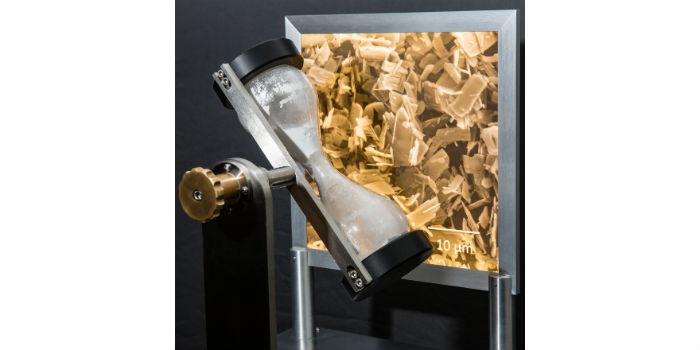
For this reason, the steel plates and beams used must have extensive and durable protection against corrosion. In particular, steel is attacked by oxygen in the air, water vapor and salts. To prevent corrosive substances from penetrating the material, a common method is to create an anticorrosive coating by applying layers of zinc-phosphate particle paint. Now, researchers at the Leibniz Institute for New Materials (INM) have developed a special type of zinc-phosphate particles: they are flake-shaped because they are ten times longer than thick.
Early experiments with these new scale-shaped particles indicate, due to their anisotropy, better solubility compared to spherical particles. "Now, more phosphate ions are dissolved and repasivated from the base metal surface; for example, as a consequence of mechanical damage, it is better and faster," said Carsten Becker-Willinger, division head of the Nanomers program.
"In the first coating tests we were also able to show that flake-type particles are deposited in layers on top of each other, thus creating a wall-like structure, which means that the penetration of gas molecules through the protective coating is greater, since the result is that the corrosion process was much slower than with coatings with spheroidal particles, where gas molecules can find their way through the protective layer to the metal more quickly.
In other series of tests, the scientists were able to validate the effectiveness of the new particles. To do this, they immersed steel plates both in electrolytic solutions with spheroidal zinc-phosphate particles and with zinc-phosphate particles in the form of flakes. After a few hours, the steel plates on the electrolytes with spheroidal particles showed signs of corrosion, while the steel plates on the electrolytes with flake-like particles were still in perfect condition, even after three days. Zinc-phosphate particles in the form of scales are synthesized in a controlled precipitation process.
Data Source Provider: Leibniz Institute for New Materials