
United States.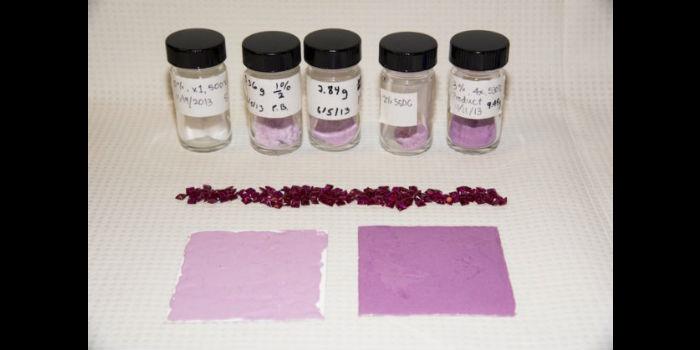 Scientists determined that certain dark pigments can remain as fresh as white by using fluorescence.
Researchers at the Berkeley lab tested this concept by coloring fresh roof coverings with ruby red (chromium-doped aluminum oxide). Led by Berkeley Lab scientist Paul Berdahl, they found for the first time that white paint superimposed with a layer of ruby crystals remained as fresh as a commercial white coating. Next, they synthesized the ruby pigment to mix into coatings.
Substantial research over the years from the Heat Island Group lab has found that reflective ceilings and walls can refresh buildings and cars. This reduces the need for air conditioning and mitigates the urban heat island effect. By reflecting the sun's rays back into space, these cool materials also release less heat into the atmosphere, thus cooling the planet and offsetting the warming effects of substantial amounts of greenhouse gas emissions.
The use of fluorescence, or photoluminescence, for fresh materials is a new concept, and Berdahl, who is a physicist by training, has a patent pending on the technology. "People understand that materials that fluoresce are emitting energy," he said. "What's new here is the use of the fluorescence process to keep buildings cooler."
When light reaches a fluorescent material, the material actively emits energy in response, rather than passively reflecting the energy. Berdahl's idea was to find a material that would absorb visible light and fluorescerate (re-emit) mostly or entirely in the invisible near-infrared portion of the sun's spectrum. "Thousands of fluorescent compounds have been identified," he said, "Ruby's properties are well known and well studied, and I realized it's a material that could work."
His first experiment was to use a series of synthetic ruby crystals, which he bought online and said were surprisingly cheap. Tied to a bright white coating and exposed to bright sunlight, the dark red ruby-covered coating remained cooler than a whitish surface.
Berdahl synthesized ruby powder, or aluminum oxide, doped with different amounts of chromium to create different shades of red pigment. He prepared ruby paint from the powders and applied these paints on bright white substrates. When exposed to sunlight, ruby paint samples remained as cold as white materials. "Ruby powder needs more work to make it as red as ruby crystal," Berdahl said.
If the product were to be marketed, Berdahl said the cost is not expected to be substantial and its durability is expected to be similar to other coatings. "Rubies have a reputation for being expensive, but they're mostly aluminum oxide, which sells for about 70 cents per kilogram (or about 30 cents per pound)," he said.
PPG Industries, also involved in the research, is conducting weathering tests with prototype fluorescent coatings. In the follow-up work Berdahl has identified the blue materials that also fluoresce and showed that they can be combined with other colors to produce the green and still black materials that remain fresh.
Source: Berkeley Lab.