
International.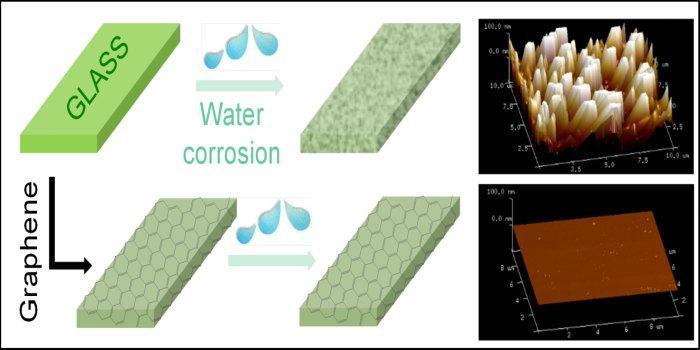 Researchers at the Center for Multidimensional Carbon Materials (CMCM), within Korea's Institute of Basic Sciences (IBS) have shown that graphene coating protects glass from corrosion. Their research, published in ACS Nano, may contribute to solving problems related to glass corrosion in various industries.
Glass has a high degree of corrosion and chemical resistance. For this reason, it is the main packaging material for preserving medicines and chemicals. However, over time at high humidity and pH, some types of glass corrode. Corroded glass loses its transparency and its strength is reduced. As a result, corrosion of silicate glass, the most common and oldest form of glass, by water is a serious problem especially for the pharmaceutical, environmental and optical industries, and in particular in hot and humid climates.
Although there are different types of glass, ordinary glazing and containers are made of silicon dioxide (SiO2), sodium oxide (Na2O) along with minor additives. Corrosion of glass begins with the adsorption of water on the surface of the glass. The hydrogen ions from the water then diffuse into the glass and exchange with the sodium ions present on the surface of the glass. The pH of the water near the surface of the glass increases, allowing the silicate structure to dissolve.
Scientists have been looking at how to cover glass to protect it from damage. An ideal protective coating should be thin, transparent and should provide a good diffusion barrier to chemical attack. Graphene with its chemical inertia, thinness and high transparency makes it very promising as a coating material. In addition, due to its excellent chemical barrier properties, it prevents helium atoms from penetrating through it. The use of graphene coating is being explored as a protective layer for other materials that require resistance to corrosion, oxidation, friction, bacterial infection, electromagnetic radiation, etc.
Graphene on copper culture
- IBS scientists grew graphene on copper using a technique previously invented by Prof. Rodney S. Ruoff and collaborators.
- They transferred one or two thick layers of graphene atom to both sides of rectangular pieces of glass.
- The effectiveness of the graphene coating was evaluated by water immersion testing and by looking at the differences between uncoated and coated glass.
- After 120 days of immersion in water at 60 ◦ C, the uncoated glass samples significantly increased surface roughness and defects, and reduced fracture resistance.
- By contrast, both single-layer graphene-coated and double-layer lenses had essentially no change in both fracture strength and surface roughness.
Source: Institute for Basic Science (IBS).