
United States.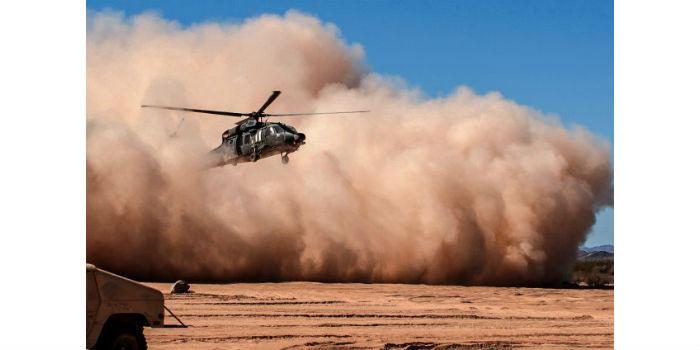 At the U.S. Army Research Laboratory, scientists and engineers have experimented with coatings in high-temperature environments with the goal of creating something — anything — that causes sand to slide out of the inside of a turbine engine like an egg slides out of a nonstick skillet.
"We are going through a very methodical process to understand the underlying science and then use the science to predict the materials, what we call the designed or adapted materials, that will lead to the right solution," explained Dr. Anindya Ghoshal, chief scientist at the Vehicle Technology Directorate laboratory.
"Our goal is for the particles to hit the blades or vanes [inside a gas turbine engine] and then come off," he said. When we started studying this problem, we found that to look at a very basic level of research we want to understand physico-chemical behavior. Once we can do that, then our idea is to take that model and then predict the type of material that would allow us to develop this sandphobic coating."
Computer simulations are also helping researchers come up with a technological solution. "Computer modeling will play an important role in helping us observe the interactions between particles and the surface," said Dr. Muthuvel Murugan, team leader of the turbomachine research laboratory. "The particles go through a phase change from solid to liquid and then settle on the surface."
At the Army's Vehicle Research Laboratory, the team filmed high-speed videos, revealing molten sand particles splashing the material targets of turbine blades and then vaporizing — a first in the scientific community.
"We will use advanced computational fluid dynamics along with particle ingestion to better understand the mechanisms of interaction of sand particles at the relevant high temperatures of the gas turbine," he said. "When we simulate how the particles pass through the flow field and impact and adhere to the surface, then we can understand the vulnerable parts of the turbine blade and engineer a sand coating solution."
Source: The U.S. Army Research Laboratory.