
United States. 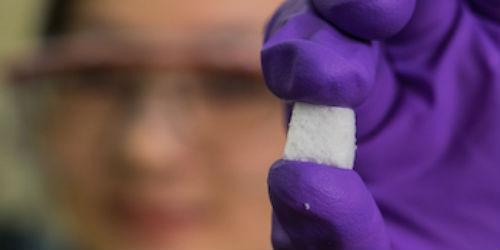 The material invented by Rice University, called SAC (for self-adaptive compound) consists of what amounts to micrometer-scale, sticky rubber balls that form a solid matrix.
The researchers made the SAC by mixing two polymers and a solvent that evaporates when heated, leaving a porous mass of sticky spheres. When it cracks, the matrix heals quickly, again and again. And just like a sponge, it returns to its original shape after compression.
The researchers suggest that SAC may be a biocompatible material useful for tissue engineering or a lightweight structural component tolerant to defects.
Other "self-healing" materials encapsulate liquid in solid deposits that let out their healing content when it cracks. "Those are very fresh, but we wanted to introduce more flexibility," said Pei Dong, a postdoctoral researcher who co-led the study with Rice graduate student Alin Cristian Chipara. "We wanted a biomimetic material that could change itself, or its internal structure, to suit external stimulation and we thought introducing more fluid would be a way. But we wanted the liquid to be stable instead of flowing everywhere."