
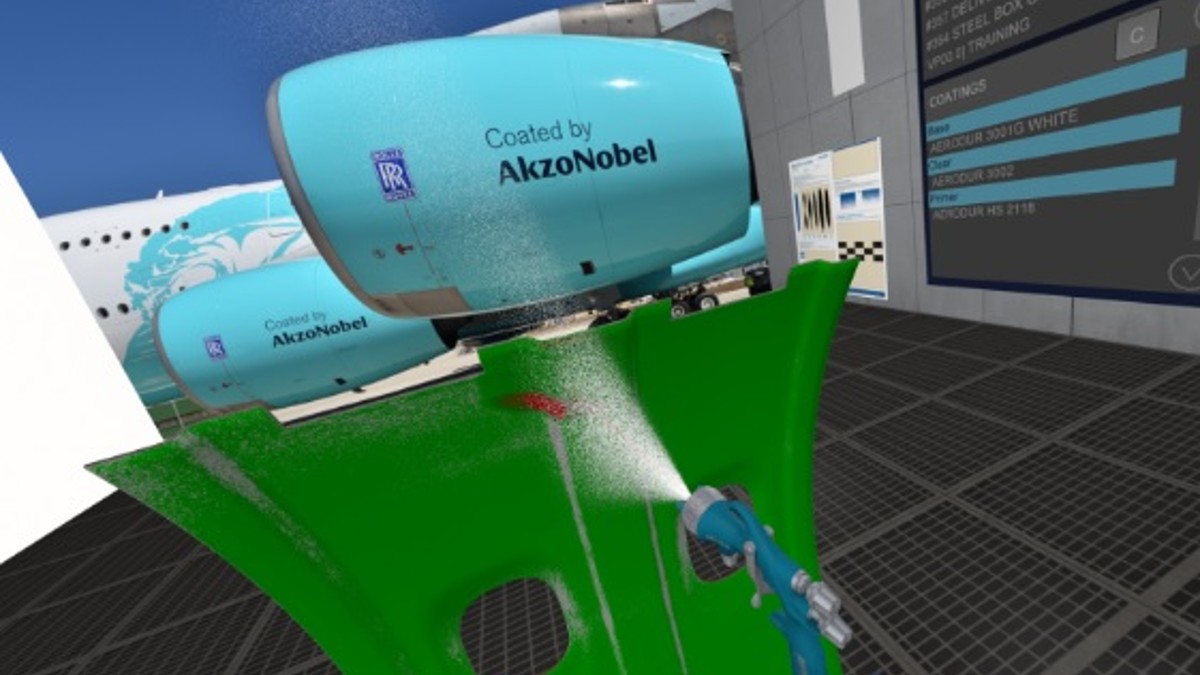
International. The system, developed with technology specialists from Virtual Paint Products, was tested at the company's training center in Troy, Michigan.
At a National Commercial Aviation Association (NBAA) event in Orlando, AkzoNobel unveiled a new innovation in training that takes a virtual reality approach to painting an airplane.
It is a technology that mimics a customer's manufacturing environment and multiple coating systems to train teams virtually and in a more sustainable and efficient way.
After successful test results, several portable units were designed for use at the customer's own premises. The virtual reality (VR) headset immerses the learner in a virtual paint booth, complete with everything from aircraft parts to large-scale assemblies and the production floor itself.
The system can be programmed with different paint specifications, such as thickness, and when the operator uses the spray gun, they can see if too much or too little paint is being used and look for inconsistencies in the way the coating is applied.
The system is also capable of assessing the operator's key skills, from setting up the spray session to the distance, angle and speed at which the gun is used. Feedback is immediate, so learners can react quickly and change their technique to be more consistent.
Jeremiah Treloar, CEO of Virtual Paint Products, says the new system accommodates all levels of training requirements: "Training is not only useful for onboarding new apprentices, but it's also great for teaching advanced skills to more experienced operators."
According to the multinational, these can practice spraying more difficult parts with rivets, difficult corners and curves, and on a moving production line. It allows the painter to "walk" the part before spraying wet material on it and, in doing so, helps reduce the likelihood of defects.
"It also helps experienced painters teach new painter techniques on difficult pieces or assemblages," Treloar says.
"If an apprentice or experienced trainee has difficulty understanding how to improve their technique, the trainer can play a video of the session and explain it. Additional training tools and videos incorporated into the system also improve the quality of training and ultimately the quality of the workforce."
"Trainees using the system are fully certified to aviation industry standards," continues Treloar.