
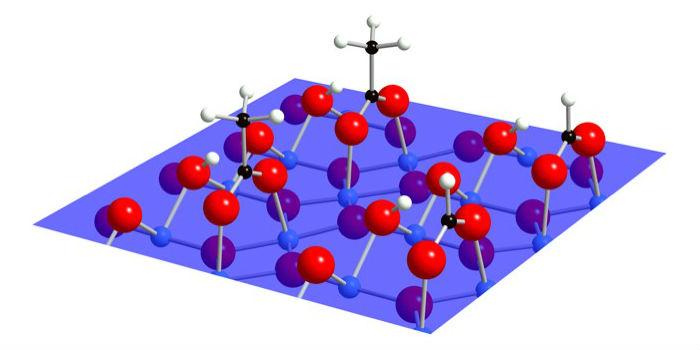
 International. Titanium dioxide is one of several self-cleaning minerals; they use the sun's energy to convert any "schmutz" that lands on its surface into a harmless gas, which then floats floating.
These minerals have been used as coating on everything from building plates to car mirrors, but the nature of their self-cleaning capabilities is unclear. When surfaces are examined in a vacuum, scientists see individual titanium atoms as expected, but when surfaces are examined in air or solution, an unknown molecule appears to selectively bind to all metal atoms on the surface, creating a nearly perfect thick layer of a single molecule. But what are these molecules and why don't they bind to every metal atom?
An international collaboration between the laboratories of Melissa Hines, professor of chemistry and chemical biology, and Ulrike Diebold, professor of surface science sciences at the Technical University of Vienna, Austria, has come to the surprising conclusion that these self-cleaning surfaces are covered by one of the oldest known cleaning agents: simple vinegar.
"We think what's happening is that this layer of molecules helps titanium dioxide react," said Hines, whose paper, "High affinity adsorption leads to molecularly ordered interfaces over TiO2 in air and solution," published Aug. 23 in Science. Hines is lead author; also contributing was William J.I. DeBenedetti, a doctoral student in chemistry and a member of the Hines Lab.
Using a combination of techniques, the researchers showed that when titanium dioxide is exposed to air, the surface is covered with a single-molecule layer of two organic acids: acetic acid (vinegar) and its close relative, formic acid. Both are natural byproducts of tree and shrub growth, and are present in the air at concentrations of parts per billion, in both urban and rural settings.
To confirm the findings, experimentation was conducted in both rural Ithaca and urban Vienna. "It was crucial that we conducted the experiment in more than one place," said Hines, who conducted research in Vienna during a sabbatical. "If we had done it in Vienna, everyone would say, 'For some reason, your building is full of vinegar.'
The selective binding of these molecules to self-cleaning surfaces is due to a peculiarity of their structure. Molecules have "bidentate" bonding, literally, "two teeth," allowing them to cling to surfaces at higher temperatures than other molecules, such as alcohols, which have monodented bonds.
This bidentate bond causes each molecule to bind to two titanium atoms. Since there is one molecule for every two titanium atoms, previous researchers thought the molecules were attached to only half of the titanium atoms.
This chemical understanding may help explain the self-cleaning properties of titanium dioxide. Acid molecules give the surface a "split personality." On a clear day, acid molecules will spontaneously assemble into a hydrophobic waxy layer ("water repellent") on the surface that will repel many types of molecules.
On rainy days, however, the acids will clear quickly, exposing a hydrophilic ("water-loving") surface that is crucial to the action of the sheet that rinses off dust and other particles.
Despite this new understanding, many mysteries remain with this material, and Cornell researchers are investigating the role of sunlight in the self-cleaning process.
"In some ways, these molecules on the surface are helping with this really interesting chemistry, the self-cleaning and oxidation properties," Hines said. "And we're just starting to understand what's going on there."
Other contributors came from the Brno University of Technology in the Czech Republic. Support for this work came from the National Science Foundation, the U.S. Department of Energy's National Scientific Calculation Center for Energy Research, the Austrian Scientific Fund, and the European Research Council.
Source: Cornell.