
 United States. Researchers at Brown University have demonstrated a way to use graphene oxide (GO) to add some spine to hydrogel materials made of alginate, a natural material derived from seaweed that is currently used in a variety of biomedical applications.
In a paper published in the journal Carbon, the researchers describe a 3D printing method for creating intricate and durable alginate-GO structures that are much stiffer and more resistant to fractures than alginate alone.
"A limiting factor in the use of alginate hydrogels is that they are very fragile: they tend to crumble under mechanical load or in low-salt solutions," said Thomas Valentin, Ph.D., a student in the Brown School of Engineering who led the work. "What we show is that by including nano-sheets of graphene oxide, we can make these structures much more robust."
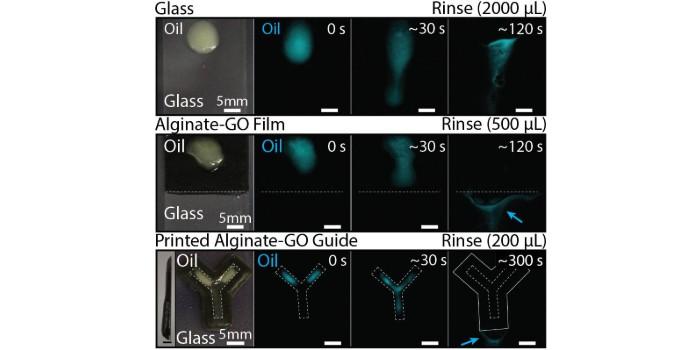
Research shows that the material can also become stiffer or softer in response to different chemical treatments, meaning it could be used to make "smart" materials that can react to their environment in real time. In addition, alginate-GO retains alginate's ability to repel oils, giving the new material potential as a tough antifouling coating.
The 3D printing method used to make the materials is known as stereolithography. The technique uses an ultraviolet laser controlled by a computer-aided design system to track patterns across the surface of a photoactive polymer solution. The light causes the polymers to bind together, forming solid 3D structures of the solution. The crawling process is repeated until an entire object is constructed layer by layer from the bottom up. In this case, the polymer solution was manufactured using sodium alginate mixed with sheets of graphene oxide, a carbon-based material that forms nano-sheets one atom thick that are stronger pound by pound than steel.
An advantage of the technique is that sodium alginate polymers bind through ionic bonds. The bonds are strong enough to hold the material together, but they can break with certain chemical treatments. That gives the material the ability to respond dynamically to external stimuli. Previously, Brown's researchers demonstrated that this "ion cross-linking" can be used to create alginate materials that degrade in demand and dissolve quickly when treated with a chemical that removes ions from the material's internal structure.
For this new study, the researchers wanted to see how graphene oxide could change the mechanical properties of alginate structures. They showed that alginate-GO could be made twice as rigid as alginate alone, and much more resistant to failure through cracking.
Data Source Provider: Brown University.