
 International. A team of researchers is developing a new way to create a series of nanofibers that could replicate some of these fantastic features found in nature, according to a new study published in the journal Science.
"This is so different from anything I've seen that I would have thought it's impossible," said Joerg Lahann, a professor of chemical engineering at the University of Michigan and lead author of the study.
Researchers from the University of Michigan and the University of Wisconsin made the somewhat haphazard discovery that revealed a powerful new method for making fibers that are hundreds of times thinner than human hair.
"Fundamentally, this is a completely different way of making series of nanofibers," Lahann said.
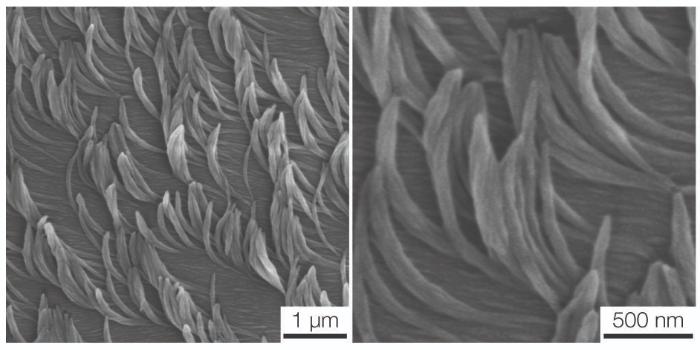
Researchers have shown that their nanofibers repel water like lotus leaves. They made straight, curved fibers, and tested how they stuck together like Velcro, finding that crooked fibers clockwise and counterclockwise bonded more closely than two sets of straight fibers.
They also experimented with optical properties, making a material that shines. They believe it will be possible to make a structure that functions like the skin of a polar bear, with individual fibers structured to channel light.
But molecular carpets were not part of the original plan. Lahann's group was working with that of Nicholas Abbott, who at the time was a professor of chemical engineering at the University of Wisconsin-Madison, to put thin films of chain-like molecules, called polymers, on liquid crystals. Liquid crystals are best known for their use in screens such as televisions and computer screens. They were trying to make sensors that could detect individual molecules.
Lahann brought the expertise in thin film production, while Abbott led the design and production of the liquid crystals. In typical experiments, Lahann's group evaporates individual bonds from a chain and forces them to condense on surfaces. But thin polymer films sometimes did not materialize as expected.
Instead of coating the top of the liquid crystal, the bonds slipped into the fluid and connected to each other on the glass slide. The liquid crystal then guided the shapes of the nanofibers growing from the bottom, creating nanoscale carpets.
"The discovery reinforces my view that the best advances in science and engineering happen when things don't go as planned," Abbott said. "You just have to be alert and see failed experiments as opportunities."
"A liquid crystal is a relatively disordered fluid, although it can shape the formation of nanofibers with very well-defined lengths and diameters," Abbott said.
And they don't just make straight strands. Depending on the liquid crystal, they could generate curved fibers, such as microscopic bananas or ladders.
"We have a lot of control over the chemistry, the type of fibers, the architecture of the fibers and the way we deposit them," Lahann said. "This really adds a lot of complexity to the way we can design surfaces now; not just with two-dimensional thin films but in three dimensions."
The study is titled "Templated nanofiber synthesis via chemical vapor polymerization into liquid crystalline films."
The investigation was supported by the Army Bureau of Investigation.
Lahann is also director of U-M's Biointerfaces Institute and professor of materials science and engineering, biomedical engineering, and macromolecular science and engineering. Abbott is now a professor at Tisch University and a professor of chemical and biomolecular engineering at Cornell University.
Source: University of Michigan.