
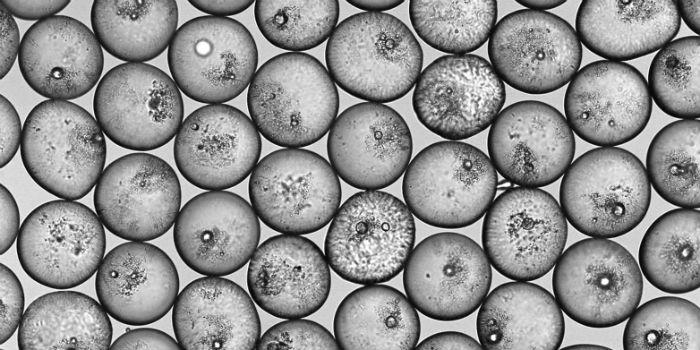
 International. Materials researchers from ETH Zurich and the Belgian University of Leuven (KU Leuven), working under the direction of Eth Professor Jan Vermant, have developed a new method with which they can attack droplet interfaces in emulsions to coat and design them with the most diverse particles.
"Using the classic approach: mixing two liquids with an emulsifier, stirring and seeing the result, it is impossible to arrange defined amounts of an emulsifier at the interface of the drops," Vermant emphasizes. "There is an element of opportunity."
With the new method it is now possible to calculate in advance and set the number of particles needed to achieve the correct degree of coverage. Researchers have also arbitrarily found many different options for the particles they intend to use and how big they may be. Spherical silica particles are the most commonly used, but for testing they also used worm- or rod-shaped particles. Proteins and polymers are now also options to use as emulsifiers.
"This approach opens up unimaginable opportunities that we can use to create new materials," says ETH professor Vermant.
Their method is based on a microfluidic platform the size of a microscope slide. Researchers can produce small droplets using this platform. As the droplets form, the second phase begins with the particles attaching to the droplet interfaces.
The number of particles is controlled by the researchers using the flow rate with which the particle phase moves through the developing droplets. Finally, this layer is surrounded by the phase in which the drops fall at rest (water in the case of oil drops, or vice versa).
The finished droplets then flow through a narrow and very long channel in the form of a radiator. As it travels through this channel, the phase surrounding the droplets containing the particles gradually dissolves into the surrounding solution. But there is still enough time for the particles to cover the interfaces of the droplets and stabilize them.
Depending on the intended purpose, the droplets can be covered with various types of particles. Researchers can also use particles of different sizes, various chemical compositions, or even different polarities (hydrophobic versus hydrophilic).
Individual drops can be joined according to the degree of coverage. This gives rise to peanut-like shapes. Coalescence changes the ratio of volume to surface area, which means that there is less space available for particles at the interface.
Particles covering two droplets are forced to move together in a smaller area, and the coverage of the double drop increases in density. Coated droplets are stabilized in this way, as is emulsion, the properties of which are also derived from the shape and length of the droplets.
The method described here is only suitable for research because it only works on a very small scale. However, ETH researchers are working on scaling up to process large quantities. They are developing an apparatus that would already be suitable for industrial test methods based on sales and performance.
On an even larger scale, applications in the food, pharmaceutical, cosmetic and even oil industries would be possible, for example, the separation of oil and water during oil extraction.
Source: ETH Zurich.