
 United States. A material designed by MIT chemical engineers can react with carbon dioxide from the air to grow, strengthen and even repair itself. The polymer, which could one day be used as a building or repair material or for protective coatings, continuously converts the greenhouse gas into a carbon-based material that reinforces itself.
The current version of the new material is a gel-like synthetic substance that performs a chemical process similar to the way plants incorporate carbon dioxide from the air into their growing tissues. The material could, for example, be converted into panels of a lightweight matrix that could be sent to a construction site, where they would harden and solidify only from exposure to air and sunlight, thus saving energy and transportation cost.
The finding is described in a paper in the journal Advanced Materials, by Professor Michael Strano, a Seon-Yeong Kwak postdoc, and eight others at MIT and the University of California, Riverside.
"This is a whole new concept in materials science," says Strano, a Carbon C. Dubbs Professor of Chemical Engineering. "What we call carbon-fixing materials don't yet exist today" outside the biological realm, he says, describing materials that can transform carbon dioxide in ambient air into a solid, stable form, using only the power of sunlight, only as plants do.
The development of a synthetic material that not only avoids the use of fossil fuels for its creation, but actually consumes carbon dioxide from the air, has obvious benefits for the environment and climate, the researchers note. "Imagine a synthetic material that can grow like trees, taking carbon from carbon dioxide and incorporating it into the backbone of the material," Strano says.
The material the team used in these initial proof-of-concept experiments made use of a biological component: chloroplasts, the light-harnessing components within plant cells, which the researchers obtained from spinach leaves. Chloroplasts are not alive, but catalyze the reaction of carbon dioxide to glucose. Isolated chloroplasts are quite unstable, which means they tend to stop working after a few hours when removed from the plant. In their paper, Strano and his collaborators demonstrate methods to significantly increase the catalytic life of the extracted chloroplasts. In ongoing and future work, the chloroplast is being replaced by catalysts that are not of biological origin, Strano explains.
The material used by the researchers, a gel matrix composed of a polymer made of aminopropyl methacrylamide (APMA) and glucose, an enzyme called glucose oxidase and chloroplasts, becomes stronger as it incorporates carbon. The researchers note that it is not yet strong enough to be used as a building material, although it could function as a crack filler or coating material.
The team has developed methods for producing materials of this type per ton, and is now focusing on optimizing the material's properties. Commercial applications such as self-healing coatings and crack filling can be realized in the short term, they say, while additional advances in spine chemistry and materials science are needed before building materials and composite materials can be developed.
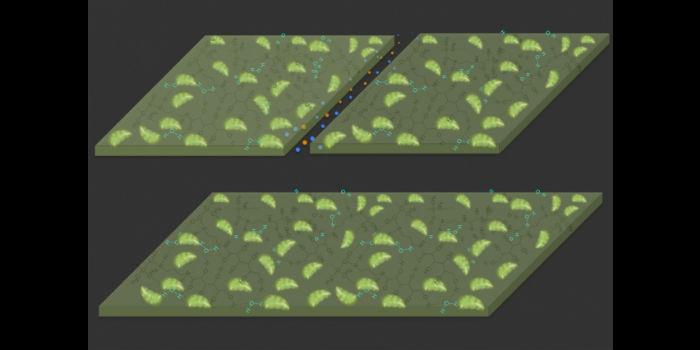
One of the key advantages of these materials is that they would repair themselves after exposure to sunlight or some interior lighting, Strano says. If the surface is scratched or cracked, the affected area grows to fill in the gaps and repair the damage, without requiring any external action.
Source: MIT.