
 International. Researchers from four organizations—NIST and industrial partners Eastman Chemical Co., Hyundai America Technical Center, and Anton Paar USA—describe three versions of a fast and reliable laboratory method for simulating scratch processes in transparent automotive lacquers (the top layer, or surface, of an outer coating composed of polymer).
The tests are designed to give manufacturers a better understanding of the mechanisms behind those processes so that future coating materials can be more scratch-resistant and flexible.
Stronger and more robust coatings are important to meet both consumer and industrial demands. For example, statistics show that:
- People keep their cars longer and want them to remain attractive (car owners for more than two years increased 41 percent between 2006 and 2015)
- Nearly 600,000 drivers work for rideshare services in the United States that require them to maintain the appearance of the vehicle
- Improved paint durability is consistently among the top three performance requirements for OEMs
- 60 percent of all consumer complaints about cars are attributed to paint scratches and splinter imperfections
Currently, manufacturers of automotive coatings use two simple test methods to assess the scratch resistance of the transparent layer and predict performance in the field: the crockmeter and the Amtech-Kistler car wash. The first is a device that uses a robotic "finger" that moves back and forth with varying degrees of force to mimic the damage caused by human contact and abrasive surfaces. The latter is a rotating brush wheel that simulates the impact of car washes on transparent layers.
"Unfortunately, both methods only evaluate the performance of the transparent layer based on appearance, a qualitative measure in which results vary from test to test and do not provide the quantitative data that helps us understand what happens to automatic finishes in real life," the NIST physicist said. Li Piin Sung, one of the authors of the new paper.
"We demonstrated a test method that characterizes scratch mechanisms at the molecular level because that's where chemistry and physics happen... and where coatings can be designed to be more resistant."
The test method
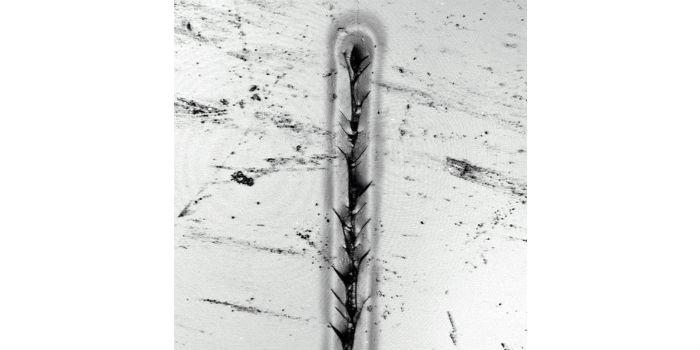
For their test method, the researchers first touched a diamond-tipped pencil on the surface of a sample composed of polymer to map its morphology, then used the stylus to create a scratch, and finally, recaped and reassigned the surface.
Three different scales of scratch tests (nano, micro and macro) were performed using different size tips and different force ranges
Quantitative differences between pre-scratching and post-scratch profiles, along with microscopic analyses of scratches, provided valuable data on vulnerability to deformation (How deep does the scratch go?), Fracture strength (How much force does it take to break the compound?) and resilience (How much does the material recover from the physical insult?)
Nano-scratch test
NIST ran the nano-scratch test with a tip radius of 1 micrometer (a micrometer is a millionth of a meter, or about one-fifth the diameter of a spider silk thread) and a range of force between 0 and 30 micronewtons (a micronewton is a millionth of a newton, or about 20 millionths of a pound of force).
Micro-scratch Test
Anton Parr did the micro-scratch test with a tip of 50 micrometers and a range of force between 25 micronewtons and 5 newtons (equivalent to 5 millionths of a pound to 1.25 pounds of force), while Eastman Chemical performed the macro-scratch test with a tip of 200 micrometers and a range of force between 0.5 and 30 newtons (equivalent to one tenth of a pound to 7.5 pounds of force).
Source: NIST.