
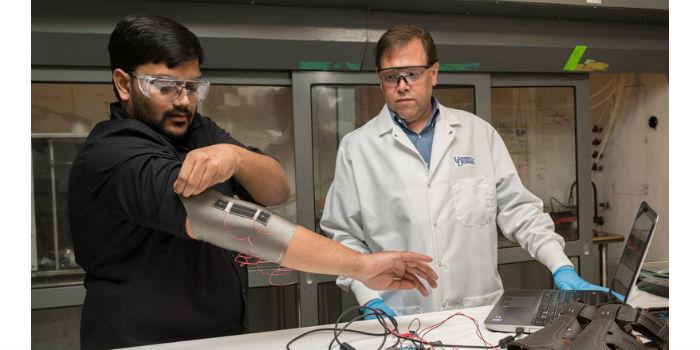
 United States. A team of engineers at the University of Delaware is developing next-generation smart textiles by creating coatings composed of flexible carbon nanotubes on a wide range of fibers, including cotton, nylon and wool.
Their discovery is reported in the journal ACS Sensors, where they demonstrate the ability to measure an exceptionally wide range of pressure, from the slight touch of the fingertip to being pushed by a forklift.
The fabric coated with this sensing technology could be used in future "smart garments" where sensors slide into the soles of shoes or sewn into clothing to detect human movement. Carbon nanotubes give this lightweight, flexible and breathable fabric an impressive sensing power. When the material is squeezed, large electrical changes in the fabric are easily measured.
"As a sensor, it's very sensitive to forces ranging from touch to tons," said Erik Thostenson, an associate professor in the Departments of Mechanical Engineering and Materials Science and Engineering.
Electrically conductive nerve-like nanocomposite coatings are created on the fibers using electrophoretic deposition (EPD) of carbon nanotubes functionalized with polyethylenemine.
Now, researchers can add these sensors to fabric in a way that is superior to current methods of making smart textiles. Existing techniques, such as coating fibers with metal or weaving fibers and strands of metal together, can decrease the comfort and durability of fabrics, said Thostenson, who directs UD's Multifunctional Composites Laboratory.
Nanocomposites
The nanocomposite coating developed by Thostenson's group is flexible and pleasant to the touch and has been tested on a range of natural and synthetic fibers, including Kevlar, wool, nylon, spandex and polyester.
The coatings are only 250 to 750 nanometers thick, about 0.25 to 0.75 percent the thickness of a paper, and would only add about a gram of weight to a typical shoe or garment. The materials used to make the sensor coating are inexpensive and relatively environmentally friendly, as they can be processed at room temperature with water as a solvent.
Data Source Provider: University of Delaware.