
 International. If a surface has to be protected against corrosion, in 80 percent of all cases this occurs by covering it with paints or varnishes. In doing so, the proportion of biological and environmentally friendly solutions is extremely small. Therefore, researchers from the Fraunhofer Institute for Research in Applied Polymers IAP, in cooperation with the Fraunhofer Institute for Manufacturing Engineering and Automation IPA, are looking to close this gap and are developing a cost-effective coating based on renewable raw materials. The target of the research is potato starch.
Climate change, limited resources and increasing burdens on the environment mean that more and more industries are focusing on sustainable production. And this is also the case in the production of coatings such as paints and varnishes. In Germany alone, 100,000 tons of coating materials for corrosion protection are produced each year. However, in the past, paints and varnishes with bio-based binders or film formers were usually too expensive or could not meet the requirements.
"In the field of paints and varnishes, starch was usually only used as an additive. With starch as the main component of a water-based dispersion, we now have very promising adhesion results. At the heart of the research is the coating of metals for indoor use, for example aluminum, which can be used, for fire doors, computer housings or window frames," says Christina Gabriel, a scientist at the Fraunhofer IAP in Potsdam-Golm.
The use of starch as the main component of paints and varnishes posed several challenges for Fraunhofer's experts. "Film formers must fulfill several tasks: they must form a continuous film, which adheres well to the substrate material, is compatible with additional layers and additives, and also embeds pigments and fillers," explains Christina Gabriel. "In its natural form, however, starch exhibits several properties, which stand in the way of its use as a film former. For example, it is not soluble in cold water and does not form continuous, non-brittle films. Therefore we had to modify starch to adapt it to the requirements, since despite all the challenges, as a renewable and cost-effective raw material, starch is of great interest to many sectors."
The Potsdam scientists' solution involves an initial degradation stage of starch in order to improve its solubility in water and the subsequent associated solids content of starch in water, as well as its film-forming ability. However, to produce a starch-based coating material, which is comparable to a conventional coating, this is still not enough, since although the film former should initially be soluble or dispersible in water, the coating should no longer be dissolved in water.
Therefore, starch needs to be further modified. This takes place through a chemical process known as esterification. The resulting starch esters are dispersible in water, form continuous films and have very good adhesive properties on glass and aluminum surfaces. In cooperation with Fraunhofer IPA, the esterified starch is "cross-linked" through which the sensitivity of the coating to water is further reduced.
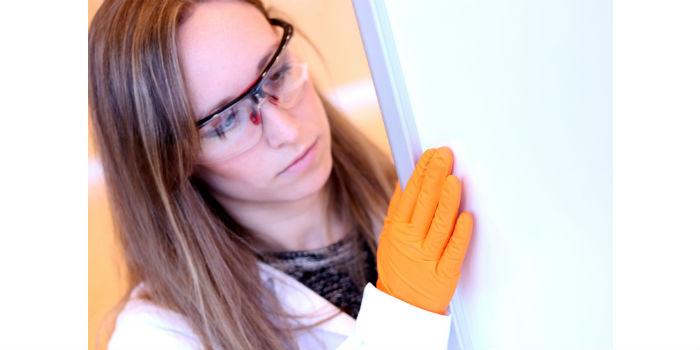
Stability tests to verify long-term stability are also carried out on the Fraunhofer IPA. In testing, coated materials are exposed to rapidly changing temperature cycles in a compressed form over time to simulate the change from day to night and the course of the seasons. In addition, test objects are exposed to electrolyte-enriched water to see how the coating reacts to water and how resilient it is under extreme conditions.
In the next step, the corrosion resistance and adhesion of the modified starch on different metal substrates is examined. New "recipes" are also being tested, which are intended to further optimize the properties of the coating. "In addition to the aluminium already tested, two other important metals, steel and galvanised steel, will be tested," says Gabriel. "Our research shows that with their good film formation and very good adhesion properties on various substrates, starch esters have the potential to be alternatives in the future to petroleum-based film formers in the coatings industry."
Source: Fraunhofer.