
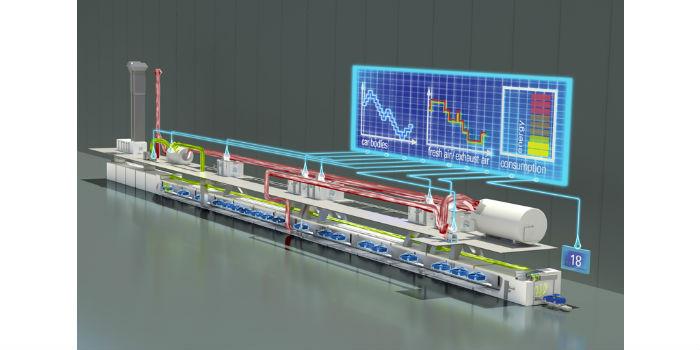
 International. Dürr revealed that he is currently building a fully automatic paint shop for a local OEM in Hefei in China's Anhui province. The plant is designed to handle 100,000 units per year, and will start operating in June 2018. The integration of numerous digital solutions from Dürr turns the paint shop into a smart factory with extensive data use.
The new Anhui Jianghuai Automobile (JAC) plant will produce battery-powered cars on behalf of a local electric car manufacturer. The vehicles will receive a modern design in two colours in the fully automatic Dürr paint shop.
The plant in Hefei combines advanced vehicle units with smart plant technology and modern paint concepts. The entire plant, including data acquisition, data evaluation and plant monitoring, is controlled by the Dürr iTAC.MES.Suite software solution. The modular MES system provides detailed information on production workflows and consumption data.
Electric vehicles often feature plastic and lightweight components, which are painted separately and not installed on the body until the final assembly line. Workflows on paint lines are adapting to these changes.
Before the bodies receive their top coat in the paint booth, they undergo pre-treatment (PT) and electrodecubration (EC). The RoDip rotational immersion process is used to apply the corrosion protection coating. The rotational movement of the bodies eliminates the need for inlet and outlet inclinations in the tank, which saves a considerable amount of space. The lower tank capacity means RoDip reduces costs per unit by using less energy, water and chemicals.
The seams on the underbody are sealed, a flat underbody protection is applied, and sound damping mats are applied to the inside of the body. This is done using the new EcoGun2 3D applicator, which is suitable for all sealing materials and processes. The new channel design in the applicator head results in a longer service life and a lower pressure level during material feeding. The innovative applicators are mounted on a total of eight EcoRS 16 or EcoRS 30L16 robots, and apply the sealing material automatically to the bodies.
The paint line consists of a primer station, as well as an interior and two exterior painting stations for the top layer. Here the bodies are removed in some cases and returned to the top line of the layer for two-tone ceiling painting. The final transparent layer is applied on fully automatic indoor and outdoor painting stations. In order to minimize solvent emissions, the outflow of exhaust air is purified from the transparent booths and paint mixing rooms.