
 United States. Physicists at the University of Cincinnati are working to harness the power of nanowires, microscopic wires that have the potential to improve solar cells or revolutionize fiber optics.
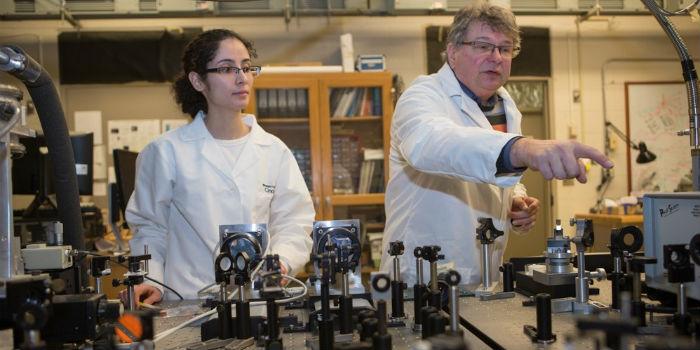
Hans-Peter Wagner, associate professor of physics and PhD student Fatemesadat Mohammadi are looking for ways to transmit data with the speed of fiber optics, but on a much smaller scale.
Wagner and lead author Mohammadi are studying this field, called plasmonics, with researchers from three other universities. For the novel experiment, they built nanowire semiconductors with organic material, fired laser pulses into the sample, and measured the way light traveled through the metal; technically, the excitations of plasmon waves.
"So, if we can have a better understanding of the coupling between excitations in semiconductor nanowires and metal films, it could open up a lot of new perspectives," Wagner said.
Successful harnessing this phenomenon — called plasmon wave guidance — could allow researchers to transmit data with light at a nano level.
Organic material has the added benefit of also containing excitons that, properly arranged, could support the flow of energy in a semiconductor:
- Coating the nanorods with gold significantly shortens the lifetime of exciton emission resulting in what is called a muted photoluminescence.
- By using organic spacers between the nanorod and the gold film, the researchers are able to extend the life of the emission to almost the equivalent of nanorods without a coating.
- Once the gold-coated sample is prepared, it is taken to an adjacent laboratory and subjected to laser light pulses.
- Mohammadi said it took days of laborious work to fix the small mirror town and bolt the beam dividers at precise angles to a workbench for the experiment.
Reactions in the nanowire take only 10 picoseconds (which is a trillionth of a second). And the laser pulses are even faster – 20 femtoseconds (a figure that has 15 zeros following it or a quadrillionth of a second). The UC project used a layer of gold so that the experiments could be replicated at a later date without risk of oxidation. Traditional coatings like silver, Mohammadi said, are even more promising.
Source: University of Cincinnati.