
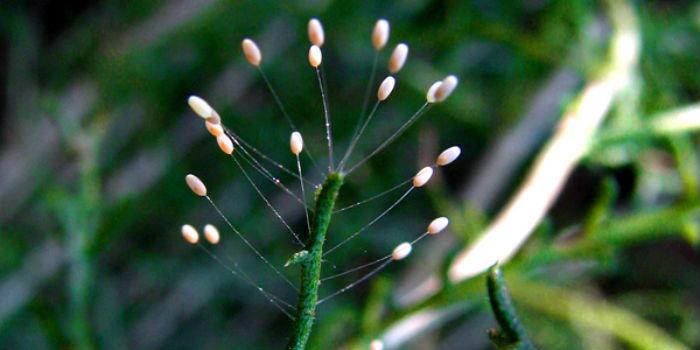
 International. Innovative biofibers made from a silk protein from green chrysolar are being developed at the Fraunhofer Institute for Applied Polymer Research IAP in collaboration with the company AMSilk GmbH.
Researchers are working on producing the protein in large quantities by using biotechnology.
The aim is to use the material in the future as a high-grade rigid fibre, for example in lightweight plastics in transport technology. It can also be conceivably used in medical technology, for example, as a biocompatible layer of silk over implants.
In order to protect their young from being eaten by predators near the ground, green chrysoperlas lay their eggs on the underside of the leaves - at the ends of stable silk threads. These so-called egg stems are only about 15 micrometers thick and can easily maintain the weight of the eggs. In order to produce these impressive fibers, the green chrysoperla excretes a secretion of proteins in the leaf. The egg is then placed in the droplet and extracted perpendicularly from the leaf. The resulting silk thread hardens in the air.
"Unlike most other types of silk, the eggshell of green chrysoperla has a special structure with fascinating mechanical properties: silk is extremely rigid and stable. We would like to transfer these special properties to the fibers made from this silk. However, until now it has not been possible to produce this type of silk protein in sufficient quantities and purities," explained Martin Schmidt, a biotechnologist at the Fraunhofer IAP in Potsdam-Golm.
In a joint project with the company AMSilk GmbH, the researcher is working on the manufacture of large quantities of green chrysoil silk protein with the help of bacteria using a biotechnology process. The team carried out the preliminary molecular biology work. They built a special gene sequence that allows bacteria to produce the silk protein. Martin Schmidt is now optimizing the manufacturing process at the Fraunhofer IAP so that the silk protein can be produced at low cost on an industrial scale. After this step it will be possible to develop the material.
Data Source Provider: Fraunhofer Institute.