
International.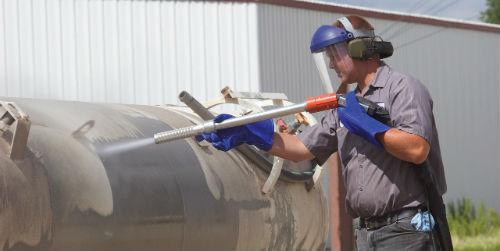 Five new SSPC - NACE standards on wet abrasive jet cleaning are now available.
SSPC (Society of Protective Coatings) explains that wet abrasive jet cleaning is primarily specified to reduce the level of dust in areas that would otherwise be prepared by dry abrasive jet cleaning.
An additional benefit of using wet methods for surface preparation is the reduction of levels of non-visible and water-soluble contaminants, such as soluble salts, which can be present on the surface and adversely affect coating performance.
Although the definitions of surface cleaning prior to coating application are the same for both wet abrasive jet and dry abrasive jet, SSPC states that wet abrasive jet cleaning standards eliminate the need to customize dry abrasive blasting standards by addressing issues such as surface oxidation levels or specialized equipment and procedures to be used with wet cleaning methods.
The recently published joint standards are as follows:
SSPC-SP 7 (WAB)/NACE WAB-4, Wet abrasive jet brushing.
SSPC-SP 14 (WAB)/NACE WAB-8, Industrial cleaning with wet abrasive jet.
SSPC-SP 6 (WAB)/NACE WAB-3, Wet abrasive jet in the commercial field.
SSPC-SP 10 (WAB)/NACE WAB-2, Cleaning close to white metal with wet abrasive jet.
SSPC-SP 5 (WAB)/NACE WAB-1, Cleaning with wet abrasive jet white metal.
The standards are intended for use by paint and coating specification writers, applicators, inspectors and others whose responsibility is to define and interpret a standard surface cleanliness for carbon steel surfaces to be achieved by wet abrasive jet cleaning.
Technical content
According to SSPC, these standards combine elements of the existing standards for dry abrasive jet cleaning with elements of the SSPC/NACE 2012 waterjet cleaning standards.
SSPC explains that because water is used to project the abrasive onto the surface, a layer of instantaneous or surface oxidation will form onto the cleaned steel as the water evaporates, so it is necessary to take into account the degrees of surface oxidation when applying a coating or system.
Due to the varied tolerance of coatings to the presence of rapid oxidation on the surface, contractors should be aware of the maximum level of instantaneous oxidation allowed that can be present in steel immediately prior to the application of the protective coating, as well as how to assess how much surface oxidation has formed.
Wet abrasive jet cleaning standards define four levels of instantaneous oxidation: no surface oxidation, light surface oxidation, moderate surface oxidation and strong surface oxidation.
These definitions are based on the extent to which instantaneous oxidation obscures the underlying steel substrate, the ease with which it can be removed by rubbing with a cloth, and the amount of material left on the cloth after passing it across the surface.
As with waterjetting standards and dry abrasive jet cleaning standards, SSPC adds that wet abrasive jet cleaning standards also include information on the materials and methods used to carry out the cleaning process.
For example, the water used must be free of contaminants that may affect the cleaning of the prepared surface and the operation of pumps or other equipment. If the project specification includes specific requirements for non-visible contaminants, the water used for waterjetting must be free of impurities that may prevent the surface from meeting those requirements.
Source: ITPTS.