
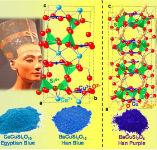
 Spain. Professors Pablo García, Antonio Aramburu and Miguel Moreno, from the Computational Physics of Materials group at the University of Cantabria, are investigating the origin of the "Egyptian blue" pigment, cataloged as the first artificial pigment in history.
According to the research, the first blue pigment synthesized by humans appears in Egypt around 3600 BC. This blue pigment, very stable, was frequently used by the Egyptian civilization as well as by the Greeks and the Roman Empire being present in Luxor, Amarna or Pompeii. This pigment is found in the crown of the bust of Queen Nefertiti, which can be seen in the "Neues Museum" in Berlin.
"In this work, we try to explain, first of all, why this pigment, with the formula CaCuSi4O10 and called Egyptian Blue, has, precisely, the intense blue color. This fact is, in principle, surprising since the color is due to the presence of CuO46 complexes - which, however, do not provide such coloration in other materials, "explained Miguel Moreno.
The study shows that the color of the "Egyptian Blue" is due, to a large extent, to the electric fields that generate the rest of the ions on the CuO46 complexes - and cause, in this case, strong displacements (~30%) of the optical transitions.
Usually, the influence of these internal electric fields is not taken into account when understanding the origin of the properties of insulating compounds that have ions such as copper (Cu2+), chromium (Cr3+) or nickel (Ni2+). Due precisely to the importance of these internal fields, it is also shown that the presence of sand (SiO2) in the pigment CaCuSi4O10 plays a key role in understanding its bright blue color.
Along with these results, the work also analyzes why two pigments made in China during the Han Dynasty, known as "Han Purple" and "Han Blue", have different coloration although this is also due to the CuO46-complexes. Likewise, it has been possible to explain the origin of the great similarity between "Egyptian Blue" and "Han Blue" as well as to understand the small differences between the two.