
 This class of coatings has different characteristics that must be known in depth to give it the most appropriate use.
by Eng. Orietta León, Eng. Pedro Ramos*
What is an epoxy painting?
Epoxy paint is a two-component coating, epoxy resin and curing agent, which must be mixed in the right proportions before use, in order to produce a film capable of adhering to certain surfaces such as walls and floors.
The epoxy resin (thermoplastic, not cured) gives the name to the paint, chemically it is a prepolymer of low molar mass that contains more than one epoxide group. For example, in the preparation of the resin it can be used as the first component epiclorohydrin-Bisphenol A and as a second component ethoxypropanol. They are marketed as epoxy resins bisphenol A, bisphenol B, hydrogenated, brominated, novolacas, multifunctional among others.
However, the curing agent, often referred to as a catalyst, activator or hardener due to specific types of curing agents, promotes or controls the curing of the epoxy resin. As a curing agent we find amines, anhydrides, polyamides, catalysts, among others. Formulations made of polyamides are the basis of user-friendly systems because the tolerance on the mixing ratio is very wide. They are sold under the name of curing agents, hardeners or aliphatic catalysts, cycloaliphatics, aromatics, polyamide, phenalcamines and phenalcamides, among others.
Throughout the curing of the epoxy resin polymerization and chain cross-linking reactions are occurring competitively, the first gives the ability of film formation to the epoxy paint while the second gives it desired properties such as good adhesion on many surfaces, chemical resistance, durability.
From the above it can be deduced that the resulting epoxy paint is a thermoset polymer, cured, that is, it is not possible for new changes of shape to occur due to the action of temperature or pressure, which makes it an insoluble and rigid material.
Why use an epoxy paint?
Epoxy paints have achieved their great commercial success due, to a large extent, to their susceptibility to a variety of formulation and application techniques in different spaces. Consequently, not only can different resins and curing agents be mixed to achieve the desired epoxy paint, but additives such as epoxy resin modifiers, reactive and non-reactive diluents, fillers and pavers, pigments and dyes, rheological additives, promoters and processing assistants can be added. These additives can be added to the epoxy resin or the curing agent as long as they do not react with the base component.
For decades paint manufacturers have marketed solvent-based epoxy paints, due to their good properties of chemical resistance and weather resistance, abrasion resistance, adhesion, fast drying resulting in durability and therefore quality.
Water-based epoxy paints are currently on the market. The solid epoxy resin is emulsified in water and the curing agent is dissolved or dispersed in water. This paint combines the good adhesion, hardness and chemical resistance of epoxy resins with the advantages of water products. Water-based epoxy resins are ideal for outdoor and indoor environments that require asepsis.
Epoxy paints are ideal for application in places with high traffic, such as industrial complexes, hospitals, storage warehouses or maritime constructions. Epoxy paints, too, are widely used as corrosion shields on metal surfaces and can give additional protection to those areas that are exposed to environmentally aggressive conditions.
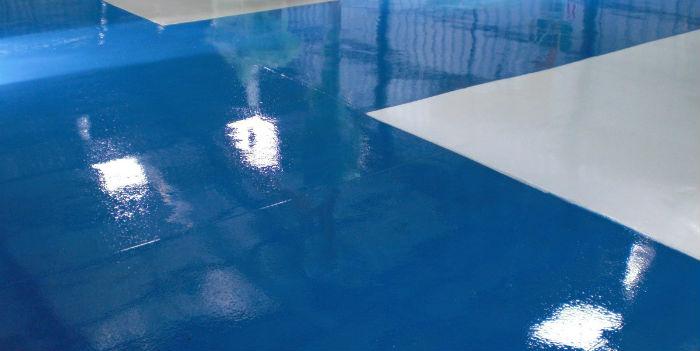
Due to their properties, epoxy paints are the solution when you want to protect and decorate walls and walls, impose a decorative style or illuminate a dark space. They are excellent as a thick layer coating or seal layer for floors such as concrete, terrazzo, metal floors, among others, they have good adhesion on concrete, so they represent an alternative to renew old concrete and improve its quality and appearance.
How to use an epoxy paint?
The application of any coating on walls or floors involves a pre-treatment of the surfaces. It must be ensured that the surface is clean, firm, dry, without traces of rust, grease, dust or loose paint. Cleaning can be done using pressurized water or air, brooms, brushes. If it is to be repainted on epoxy paint, it must be sanded dry to produce some roughness on the surface and improve adhesion. Some additional considerations should be taken for specific cases or as indicated by the manufacturer.
It is important that before the application of the epoxy paint the technical sheet is consulted to take into account any other technical requirements, influence of environmental conditions and safety precautions.
The paint can be diluted or not, this is only necessary if the application equipment or environmental conditions so require, dilute with an epoxy diluent (solvent-based epoxy paint) or water (water-based epoxy paint) maximum up to a certain percent in volume, as specified by the manufacturer.
For the preparation of the epoxy paint is mixed, in the proportions indicated by the manufacturer, a component part of the epoxy resin with a part of the curing agent, shaken very well to homogenize the product and left to rest for several minutes. Take into account that after a few hours at room temperature the product loses its properties. Then, usually with a brush or gun, 2 to 3 layers are applied on the surface until the desired thickness (75 to 100 microns minimum) is achieved, several hours are allowed to elapse between layer and layer application. Touch drying and final drying depend on conditions during application, room temperature and film thickness.
The drying to the touch is one that allows to manipulate the surface without producing great damage to the paint while the total drying or total curing is the one in which the paint has already reached its maximum state of coating on the surface.
Innovation in epoxy paints
One of the latest trends in interior design is to use the three-dimensional perspective, thanks to epoxy painting with 3D effect, to create new and personalized spaces in the rooms of homes such as exotic beaches, corals, the rainforest, old bridges surrounded by crocodiles, river banks, metropolis, a lake with swans, oceans with dolphins and endless possibilities. Imagination has no limits, so not only can these decorations be applied to floors but to entire rooms.
Designers and architects applied 3D epoxy coatings, initially, to create exclusive environments in constructions, we currently see them in shopping centers, hotels, shops and offices. Countries such as China and India used 3D epoxy paints as speed switches to prevent traffic accidents.
Epoxy paint with 3D coating is applied on solid surfaces outdoors or indoors. It must be cleaned, sanded and free of moisture. Then, the self-leveling mortar is extended, which will flow by gravity to level the surface and make it flat and smooth. Then the chosen design is made, the large print is placed the metallic effect or vinyl. Subsequently, a thick layer of translucent epoxy coating is put on to prevent chafing and damage.
Finally, a layer of non-slip polyurethane layer is applied. This is a way to apply the epoxy coating with 3D effect, this may vary depending on the company.
We coat them with epoxy 3D paints do not have joints or joints, which facilitates their cleaning and prevents the growth of fungi and bacteria. They are resistant to compression, abrasion and bending, are self-extinguishing and have thermal resistance.
The main disadvantages of 3D epoxy paints are the installation time and costs associated with materials and labor. Clearly, each layer of paint that is applied must be allowed to dry for a while in order to apply the next layer. Although companies can always adjust to the budgets of each client.
* Eng. Orietta León, Eng. Pedro Ramos
Pintumaxx Paint Factory – Colombia
https://fabricatupintura.com
Sources consulted
1. The Components of Paint. Fluorinated Coatings and Finishes Handbook. Elsevier. 2016. 51-58. http://dx.doi.org/10.1016/B978-0-323-37126-1.00003-5
2. Witold Brostow, Sidney H. Goodman and Joshua Wahrmund. Epoxies. Handbook of Thermoset Plastics. 2014. 191-252. http://dx.doi.org/10.1016/B978-1-4557-3107-7.00008-7
3. GP Bierwagen, AM Huovinen and MSH Bhuiyan. Paint Formulation. Reference Module in Materials Science and Materials Engineering. Elsevier. 2017. 1-24. doi :10.10 16/B978-0-12-803581-8.10253-X
4. Fan-Long Jin, Xiang Li and Soo-Jin Park. Synthesis and application of epoxy resins: A review. Journal of Industrial and Engineering Chemistry, 2015, vol. 29, 1-11.