
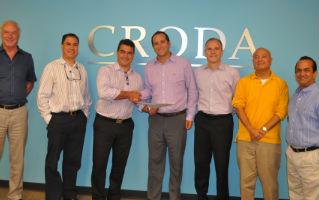
 Croda and Andes Chemical recently entered into a commercial agreement that is sure to revolutionize the paints and coatings market in the Central American and Caribbean region.
by Duván Chaverra Agudelo
Last August two important companies in the formulation sector for paints and coatings decided to join forces and work as a team seeking greater solvency and, of course, offering a broader coverage, service and support to all their customers.
It is the global manufacturer of specialty chemicals Croda, and Andes Chemical, supplier of specialty chemicals for all latin America. In a special interview with INPRA LATINA, we invited representatives of each of the companies to talk about this trade agreement and the repercussions of the business, which is focused on central America and the Caribbean.
With Richard Pino, VP PTIC of Croda Latin America and with Mauro Trevisani Chief Operating Officer Andes Chemical, we had an interesting talk, which was also broadcast live and in director through our streaming webcast service. A contunuación, each of the considerations of both guests.
INPRA LATINA: What is the trade agreement between Croda and Andes Chemical about?
Richard Pino: It is a distribution and representation agreement through which Croda and Andes seek to strengthen their presence in the Central American and Caribbean region. On the part of Croda, our policy will always be to generate close relationships with our customers to offer adequate advice and develop products with specific needs. For this, it is necessary to partner with companies that have a presence in the region and with personnel who have experience in specific areas of the market and technical knowledge.
IL: How was the agreement reached?
Mauro Trevisani: At andes Chemical we are always looking for products with technological innovation. Croda is a strategic partner that invests heavily in the development of new differential technology products. Together we will offer formulation solutions to our customers. It's a win-win for you loved companies.
IL: What are the objectives of this agreement?
Richard: From Croda's point of view, in addition to growing 20% in the market year after year, there is also the interest of establishing a commercial company to extend the service we offer to the market; it is not only to establish close contact with the customer, but to extend the quality and technical benefits and added values that accompany us".
IL: What industries does Andes Chemical cover and what does It offer in Latin America?
Mauro: In its 28 years of existence, since our founding president Fernando Espinoza started the distribution business in Miami where we have the offices and the operation, we have grown in the countries of Central America, the Caribbean and the Andean region. Today we are a strategic supplier serving more than 25 countries in the region. In addition, we have a branch in Peru opened last year that gives us a greater presence. The main segments in which we work and operate are the areas of coatings, paints, construction, pharmaceuticals, personal care and home, in addition to other industry niches in Latin America.
IL: What benefits does the realization of this agreement have for Croda and Andes Chemical?
Richard: It benefits us to rely on a technical and commercial infrastructure like the one that Andes Chemical has, the most important thing for us is to have someone with a contact and technical support with customers, it is difficult to find a distributor that has this structure and that is professional.
Mauro: Chemical specialties really need technical support and being very close to customers, the innovation of the products that Croda contemplates plus the attributes that Andes has in integrated support and logistics is important to move materials within Latin America, mainly in the Caribbean and central America; the technical support and the complete offer, also positions us as a differentiated supplier, in conjunction with Croda.
IL: When does the agreement start to take effect?
Richard: The official signing of the agreement took place in the last days of August and the business became effective from the month of September.
IL: Which countries will benefit from this fact? How does the customer benefit from this agreement?
Mauro: They are all the countries in the region. We serve everyone without exception. The great benefit for our customers is in the value proposition. Customers, in addition to purchasing high-performance products, will also have technical formulation support through our Miami-based customer innovation centers, which we believe will be available by the first half of 2015. In addition, everyone knows that Miami is a gateway to serve all of Latin America; our customers can count on logistics services, participate in technical training, develop new products and services tailored to the needs.
Richard: We have laboratories in the state of Delaware (United States), in Mexico, we are also building a laboratory in Campinas, Brazil, and we have others in Europe; all that will complement the work of Andes, there are several laboratories and technicians trained to serve customers in the region.
IL: Tell us about the latest developments created by Croda for the coatings and adhesives industry.
Richard: The most recent technologies are products developed to reduce the content of volatile organic compounds, the most used method is the change of solvent system to water-based through the use of non-migratory reactive surfactants, we also offer a range of renewable bio-based monomers that can be used in some polymers and offer excellent performance, especially when talking about the increase in hydrophobicity. This ensures better protection to weak substrates that suffer from contact with water, fire, soil and air. These technologies also include epoxy systems, polyurethanes, tars, polyurea and other products for coatings, adhesives, and even plastics. The best known are the Maxemul, Priamine, B-Tough, among others.
IL: Does Croda have more active business with other companies or do you expect to make new agreements of this kind?
Richard: Croda is a company that not only works in paints, we have cosmetics, lubricants, oils, etc. We rely on a variety of companies in America that offer us this specialized service, as Mauro said before, we are a specialty chemical company, we do not sell commodities, so we need people capable of handling a technical language with our customers.
IL: Croda works together with its customers, testing and adjusting their additives to obtain accurate results according to the product they need to formulate. With this agreement, what's going to happen to that process? Are you still going to do these tests and adjust the products to the needs?
Mauro: There is no reason to change that work methodology. We with the main partners we have take the best ideas from customers giving them a competitive differential.
IL: What is the current behavior of the paints and coatings market within the areas you cover?
Mauro: you have to separate it by each country and geographical area; in general there was a problem for those who use acrylic vinyl as an emulsion for paints, there was a problem in the supply of vinyl acetate, which generated an impact on some painters who decided to change part of their paint line in acrylic technology.
In terms of growth we have seen an increase in the consumption of water-based products instead of solvent-based ones. Which also leads us to be together with Croda, for example, although in some countries there are still difficulties in the issue of low VOC, we must say that a change is seen; in general the market grew in terms of volume although there were some difficulties mainly in the part of architectural paintings.
Richard: There is a mixture of behaviors. There are countries that develop faster and are in a stronger political moment as in the case of Colombia, Brazil has been coming out of six months of industrial recession but remains strong, and some areas evolved faster than others. Mexico is doing very well, it is growing along with the wave of growth of the United States and the Caribbean islands and the countries of Central America follow a little bit those leading technology countries and accompany them; it is natural to see that some caribbean clients are looking to grow their technology portfolio and for us it is an important time to invest more in this region.