
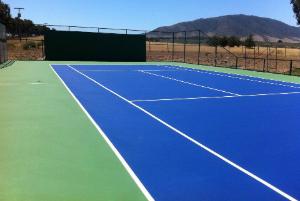
 Tennis, basketball and other disciplines depend on the quality of the coatings to offer a space suitable for the practice of sport.
by Alejandra García Vélez
Protecting against wear and tear caused by abuse, both mechanical and climatological, should be the main concern when selecting a coating for a sports floor.
While, as for the application, it is necessary to analyze the surface, observe the state of the paint in case it has already been treated before, or if it is a new project that uses masonry or concrete, perform previous treatments with auxiliary products prior to painting.
Selection: the first step
The choice of products to be used in a court must have very high resistance to rubbing, daily wear, weather factors, be waterproofing and non-slip, according to Nicolás Leoni, in charge of corporate communication of the company Basf.
Mauricio Ibarra, general manager of Globalgreen, goes a little further by explaining in detail the characteristics that must be taken into account when selecting the most suitable product for the application.
In the first place, the interviewee points out that if the court is roofed, for example, the atmospheric conditions will be less relevant, since it is possible to program the application of the product without worrying about rain, wind, or other factors that may affect the final result.
On the contrary, if it is an outdoor scenario, it is necessary to take into account the weather conditions to which the court will be exposed. "Paints must withstand the environmental conditions to which they are subjected. For example, an application that will be carried out in the desert, in a temperate climate or in a cold and rainy climate is not the same," says Ibarra.
The representative of Globalgreen explained that it is common to modify the manufacturing formulas of the paints so that they adapt better to the conditions. In arid climates and with a lot of sun it is customary to use additives that provide greater protection against UV rays, while in colder climates drying accelerants are included to facilitate the curing of the paint.
The level of cushioning that is required for the surface is another factor to consider.
Users can choose from the simplest paint or coating systems, which include an acrylic seal, two layers of acrylic paint and demarcation paints, to more sophisticated methods that include layers of intermediate rubber that provide a softer surface, capable of cushioning the impact on the joints of athletes.
Finally, the substrate on which the paints will be applied is usually asphalt or concrete. As the case may be, for new pavements a curing time of 24 days is advised on the concrete and 14 days for the asphalt.
In addition, concrete should not be polished, as it minimizes the anchoring capacity of the paint; if it is asphalt, excellent compaction is required and that it is not sealed with asphalt products, since the ideal seal is acrylic, said Ibarra.
The engineer Pablo Suárez, technical director of Kellam, also shared his point of view on this subject, pointing out that the use that is planned to be given to the sports area is also important, because the finish of the surface may depend on this, although he points out that in his country of work, Venezuela, the most common are multipurpose courts.
In his particular case, the guest commented that they recommend water-based paints over asphalt bases; because the first ones are more ecological and their application has advantages for the staff by not needing the intervention of solvents.
The application
The second step, after selecting the materials and evaluating the conditions of the project, is to move on to the application. The three guests for this article recounted some of the methods they use to ensure the quality and durability of the final product.
For example, Leoni said that a diagnosis must be made to know the state of the substrate, in addition to making sure that the surface is not found with large contaminations, in case they exist, cleaning should be done with biodegradable detergents and let dry for a minimum of three days.
Also, in case the surface is found with imperfections or wells by lifting, the repair should be made with the same type of material of the court, while if the surface is new, the official recommends letting it heal for about 45 days after finishing the work, to avoid alkaline attacks.
Finally, he indicated that "if the surface is found with paint in poor condition or with grit or dust surfaces, it is advisable to use a turpentine fixator achieving a better anchor profile for the subsequent application of the product".
Projects
The company Globalgreen, from Chile, was in charge of modifying the central court of the National Stadium to turn it into a hard court to be used during a Davis Cup tennis match.
The main challenge of the company was to convert the traditional brick powder court that occupied that space into a hard court. Among the difficulties that arose was the logistics of entering machinery to the playing surface and the atmospheric conditions of low temperatures and occasional rains.
The construction was carried out jointly by the companies Asfalchile and Globalgreen. The first was in charge of installing the asphalt layer and the second, the earthwork, the installation of the acrylic folder of the main court and the repairs and coatings in the two training courts, located in the same enclosure.
The company Asfalchile carried out the installation of the asphalt layer on the main court, which consisted of the application of an asphalt primer and later asphalt with a thickness of 40mm.
As for the coatings, for this installation Globalgreen chose to apply its seven-layer G2-Soft system, which consists of an acrylic seal, three layers of rubber and two layers of paint.
As explained by the company in charge of the installation, "the seven-layer G2-Soft system not only allows a smoother and softer game by incorporating the intermediate rubber layers, but also offers a slower game speed and more control over the players. The padding system allows players to perceive less impact on the joints."
Finally, Globlalgreen stressed that the training courts were repaired from a very deteriorated state, so they suffered countless cracks and depressions. To solve this, they used state-of-the-art products for the repair of cracks and later incorporated a three-layer system: the G2-Medium consisting of a leveling seal and two layers of acrylic paint.
The market
Finally, Mauricio Ibarra said that the construction of sports surfaces with acrylic coatings is gaining strength both for its low cost and for aspects related to the protection of the pavement and the aesthetics of the colors. "In the specific case of Chile, it is estimated that approximately 100 courts are made per year, which add up to an area of 50,000 m2," he said.
On the other hand, Nicolás Leoni, explained that the level of demand for this type of paints is quite diverse and varied, but stressed that some of the products oriented to floors are not limited to being used in sports scenarios, but can also be applied in other environments being suitable for both interior and exterior surfaces, such as garages or patios.
What the interviewees did agree on was to mention that it is increasingly common to build sports scenarios that use the properties of floor paints, and thus achieve greater resistance and duration.