
 Analysis of a novel concept in formulation that are gaining ground within the coatings sector.
by Eng. Orietta León*
Two decades ago a revolutionary new concept was developed on self-purifying coatings, based on the thermodynamic incompatibility of polymer mixtures, which allows the formation in a single step of complex multilayers or gradient structures of coatings. During the film formation process, the coating spontaneously separates within two functionally adherent continuous layers to form a thermodynamically stable layered coating [1].
The self-stratification mechanism is based on intermolecular forces that allow the separation of phases and the formation of a heterophasic polymeric structure through a diffusion process. These forces, however, cannot guide the separation of phases in an assigned direction. Thus, the binder needs a conductive force for its separation, which can be a tension gradient, a selective wetting of the substrate, contraction forces, among others [2].
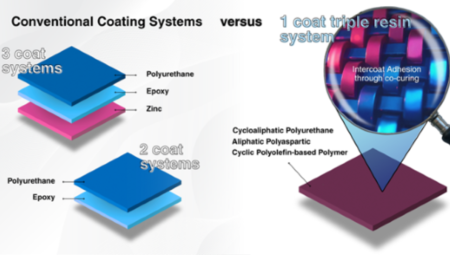
Coated systems, traditionally, are composed of different layers, each fulfilling a specific function. A typical three-layer system consists of a first inner layer, a last outer layer, and an intermediate layer. The inner layer aims to protect the material against corrosion and improve the adhesion of the coating to the substrate. The outer layer, on the other hand, provides the aesthetic appearance, durability and chemical resistance. The intermediate layer depends on the desired properties of the coating and its composition is in line with this [3].
Multilayer systems require complex formulations per layer, long application periods and curing processes. This does not always adapt to industrial restrictions, they produce environmental waste and excessive use of energy. Self-purifying coatings come to overcome these disadvantages, this concept, economical and efficient, seeks to reduce the number of capable while providing a coating with equal or better performance than traditional systems [1].
Funke et al., [4,5] applied a mixture of two powdered polymers onto a metal surface and tried to minimize interfacial free energy by heating both polymers above their melting temperature. From these results, specific formulations of self-purifying coatings were defined and patented []. Subsequently, the concept of self-purifying coatings was applied to solvent-based paints [2] and water-based paints [9] with the use of selective coagulation, electrodeposition, substrate wetting or penetration processes to create specific conductive forces for self-stratification.
Self-purifying coatings have been developed for automotive applications [6], self-healing coatings [10], corrosion-resistant or environmentally resistant solvent-based coatings [8], water-based coatings [7], among others.
As is known, a coating is formulated with a mixture of different chemical compounds that are categorized into binders, solvents, pigments and additives. The binder forms the continuous film that allows adhesion to the substrate, as binders in formulations of self-stratgrading coatings binary mixtures have been used, including or not curing agents; as an inner layer, epoxy resins are preferred, while acrylic resins, polyesters, polyurethanes, vinyls, fluoropolymers, among others, are selected as the outer layer [11].
However, solvents are liquid and volatile compounds used to adjust the viscosity of the coating for a given application. For the outer layer a solvent with high volatility and polarity is chosen given the high surface energy of the inner resin while for the inner layer a solvent with low volatility and polarity is preferred due to the low surface energy of the outer resin. Regardless of the layer where they will be applied, pure solvents or mixtures of different solvents can be used. Solvents are generally selected in a way that satisfies the solubility requirements of resins and takes into account their respective Hansen solubility parameters [10,12].
Pigments, on the other hand, are insoluble solid particles that impart, among other things, color to the coating. Its absorption properties as well as its particle size and its affinity to the medium are important for the coating. If the system is pigmented, the degree of phase separation is equal to or even better than those pigment-free coating systems. Normally, only one pigment is added, preferably titanium dioxide (TiO2), if more pigments are added these can be red iron oxide, chromium oxide and zinc phosphate, because they do not influence the stratification process [11].
Additives, such as stabilizers, flow modifiers, among others, are added to the formulation to give desired properties to the coating. For self-stratifying coatings, adhesion promoters are frequently used that promote the interaction between the resin of the dispersed medium and the pigment, which prevents a possible exchange of pigments between the two phases. In particular, a silane-based coupling agent, the amino propyl triethoxys silane, AMEO [10], is used.
The substrate-film interface is fundamental in self-stratified systems, so you must select a suitable substrate. Among the most used are steel, plastics, glass and aluminum.
* Eng. Orietta León - Pintumaxx Paint Factory – Colombia
https://fabricatupintura.com
References
1. V.V. Verkholantsev, M. Flavian, 1995. Epoxy thermoplastic heterophase and self-stratifying coatings, Mod. Paint Coat., 85, 100-106.
2. V.V. Verkholantsev, 1995. Heterophase and self stratifying polymer coating, Prog. Org. Coat., 26, 31-52.
3.C. Carr, S. Benjamin, D.J. Walbridge, 1995. Fluorinated resin inself-stratifying coatings, Eur. Coat. J., 4, 262-266.
4. W. Funke, 1976. Preparation and properties of paint films with special morphological structure, J. Oil Colour Chem. Assoc., 59, 398-403.
5. H. Murase, W. Funke, 1980. XVth FATIPEC Congress, Netherland Association of Coatings Technologists, Congress Book 2, Amsterdam, 387-409.
6. Kansai Paint Co., Ltd., 1980. UK Patent 1 570 540.
7. R. Berkau, M. Gailberger, T. Gruber, K. Holdik, G. Meichsner, F. Mezger, 2007. Coating composition for forming self-layering or self-coating lacquer systems, US Patent 7186772 B2.
8. W. Fang, 2012. Waterborne organic silicon-acrylic acid self-stratifying coating, CN Patent 101724326B.
9. I. Nikiforow, J. Adams, A.M. König, A. Langhoff, K. Pohl, A. Turshatov, D. Johannsmann, 2010. Self-stratification during film formation from latex blends driven by differences in collective diffusivity, Langmuir, 26, 13162-13167.
10. V.V. Verkholantsev, 1985. Nonhomogeneous-in-layer coatings, Prog. Org. Coat., 13, 71-96.
11. V.V. Verkholantsev, 2003. Self-stratifying coatings for industrial applications, Pigm. Resin Technol., 32, 300-306.
12. A. Toussaint, 1996. Self-stratifying coatings for plastic substrates (Brite euram project RI 1B 0246 C(H)), Prog. Org. Coat., 28, 183-195.