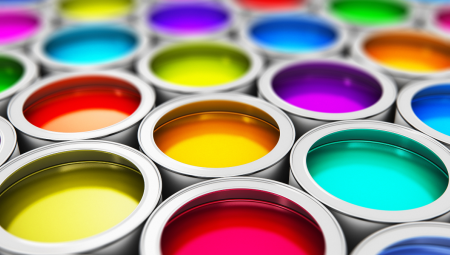

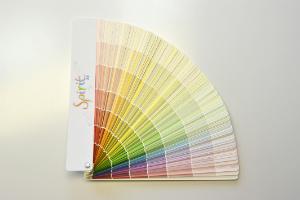
 A cost-effective way to achieve a wide variety of colors has to do with color preparation at the point of sale, which also allows you to generate substantial profits.
by CPS Color*
Paint manufacturers around the world differ greatly in the way they achieve color. While in North America, Scandinavia and Australia concentrate on the preparation of color "direct to the container" (in-can) at the point of sale (POS), in emerging markets, such as Asia and Africa, direct grinding, paint color mixing and batch color formulation dominate.
In South America, Europe and the Middle East you can find the full range of color preparation possibilities, depending on the region. Transitioning from factory-mixed paints to point-of-sale color preparation brings many benefits to manufacturers and retailers, among other important financial benefits.
The first color preparation systems in POS by liquid dispersion were launched in the United States in the 50s. They initially functioned as dye dispensers arranged in a row, but evolved in the '60s into carousel-like dispensers that are still common today.
Both systems achieved an important goal, to produce a more extensive color option palette in smaller volumes and at attractive prices. Already the first manual color preparation systems, very basic, of the first years helped to reduce delivery time, costs and inventory. Color preparation systems at PDV freed retail marketers from the frozen capital that was on their shelves in the form of prepared paints.
Currently, the increasing demand for color alternatives by consumers and a widespread shortage of space in retail outlets make the advantages of color preparation in POS even more desirable.
What should be taken into account?
Apparently, having inventories of factory-formulated paints seems to be a simple and viable option: while it requires a lot of space and stock, it doesn't need additional equipment or technical expertise.
Point-of-sale formulation, on the other hand, requires different equipment to prepare the color, among others, a dispenser, a mixer, a spectrometer, color formulation software and color marketing materials. Therefore, a complete color preparation system in POS will require an initial investment of approximately 15,000 euros1, in addition to paints and dyes.
There are three common paint types: matte, glossy, and semi-glossy. They usually come in five base paints, one transparent, medium, intense paint and two color base paints, for example red and blue. Usually, these options are sufficient to meet customer requirements and the needs of the final product.
The number and type of dyes required for a POS system will depend on the dye system selected. There are many options on the market, from universal systems to systems for specific technologies, or systems with few or no volatile organic components (VOCs). In order to develop accurate color formulas it is necessary to ensure compatibility between the dye and the base paint.
With over 10,000 different colors that can be created instantly, color accuracy and reproducibility are critical to the success of a color preparation system in POS.
Forms of color preparation
Moving from factory-made formulations to in-store color preparation obviously involves an investment in new equipment and material. However, the initial investment of approximately 15,000 euros is recovered very easily, as illustrated by the following example.
Let's imagine that a retail marketer has three types of paint with factory formulation: matte, glossy and semi-glossy. It offers one hundred colors of each type in three sizes and you need to have at least ten cans of each in inventory. This means having an inventory of 42,000 liters of paint.
Figure 1.
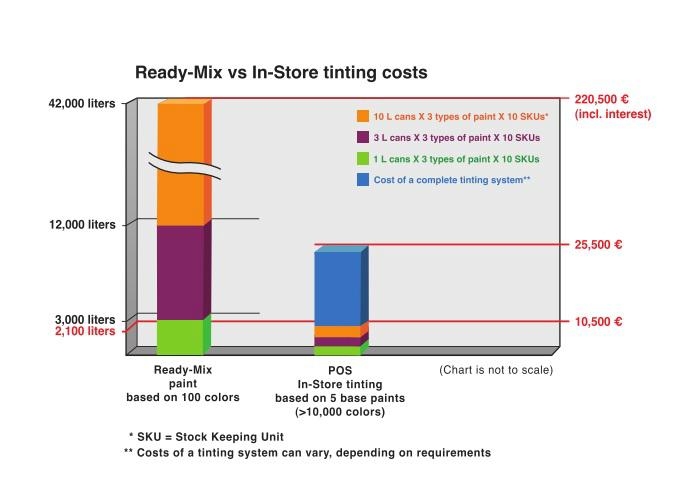
If we calculate a purchase price of five euros per liter, the retailer has invested 210,000 euros in stocks of ready-mix paint. If we add 5% interest, as the cost of that capital, the sum amounts to 220,500 euros. Following the common rule that only 20% of the paint in inventory has a reasonable turnover, while 80% is composed of lower selling products, this means that most of the invested capital is lost. If the paint has not been sold before its expiration date, the retailer will not recoup your investment, much less make a profit.
With a color formulation system in POS, the situation is very different: the retailer keeps all three types of paint (matte, glossy and semi-glossy), but instead of having 100 colors in inventory, it keeps five different types of base paint: one transparent, one medium, one intense and two color bases. These five bases will be prepared at the time of purchase. Therefore, it is only necessary to have ten cans of each type in three sizes. Instead of keeping 42,000 liters of inventory in pre-prepared paints, the store now only has to have 2,100 liters.
At a purchase price of five euros, the retailer will only have invested 10,500 euros. If we add 15,000 euros of the base equipment, the investment amounts to 25,500 euros. Compared to the investment of 220,500 euros from the inventory of ready-made paints, the retailer saves 195,000 euros, which is equivalent to 88.6%. In other words, your investment in factory-formulated paint inventory immobilizes 7.5 times more capital than the color preparation option in POS.
What the customer sees is what they get
As the example illustrates, color formulation in POS offers a clear financial benefit to retail paint marketers. The other undeniable benefit is the color options. A selection of a hundred colors does not allow variety and yet it is a logistical challenge of the formulation made in the factory. Even more importantly, a hundred colors are by no means sufficient to meet the demands of today's market. Today's customers expect to be able to select shades from different color charts that offer more than 10,000 colors. This level of accuracy and variety in color can only be achieved with color preparation in POS.
In addition to the logistical and financial advantages, opting for color preparation in POS is a service-oriented decision and means a relevant investment in the customer. Some retailers may feel concerned about driving customers away by shifting their offering from factory-formulated paints to those prepared at the POS. However, if these are presented and positioned properly, just the opposite can happen.
With a POS system, retailers can start using color as a sales tool. The customer can bring a sample of the color they expect to get, either a flower they picked up or a tile from their kitchen. A complete color chart will allow you to find the exact color. The retailer can be sure that the quality of their color preparation system will be able to achieve the exact shade; not only when the customer buys the paint for the first time, but also when he returns several weeks later for more, or to make some retouching to his painting.
Many retailers opt for a combination of color formulation in POS and pre-prepared paints. While the best rotating paints can be offered in premixed batches, the colors that are least used can be prepared at the point of sale, eliminating frozen capital and avoiding expiration losses.
Switching to color preparation in POS is a clearly beneficial decision, as it allows you to provide the flexibility and variety necessary to meet the current and future needs of paint companies.
*CPS Color is a provider of color preparation solutions for the global paint and coating industry.