
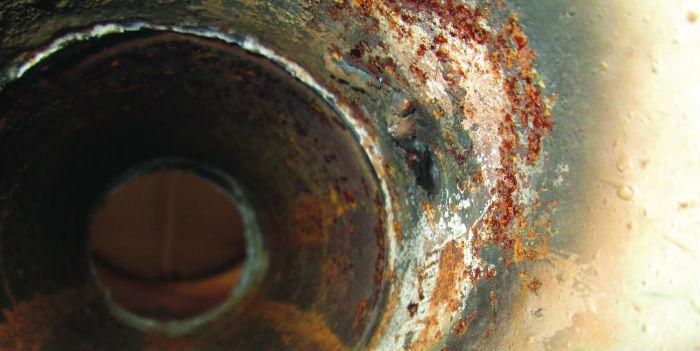
 A series of recommendations to identify pipelines and pipes at risk or in the process of corrosion.
by Juan Manuel Álvarez*
Ducts and pipes, such as structural elements or components, have something in particular that makes a difference with other structures: there are fluids that are transported inside. These fluids can have different properties or characteristics such as density and viscosity, temperature, pressure, suspended solids, and others that have an interference in the formation of some type of corrosion and require a protection system or a correct selection of materials.
We could take different examples:
A pipe that carries drinking water.
A pipe that carries wastewater.
A pipeline that transports crude oil.
A pipeline that transports gas.
The above examples allow us to glimpse the above: the type of material of the pipes and ducts should not be the same, and in turn the protection system of the material of the pipe or the duct would not be the same either.
In relation to the formation of corrosion products, the variables of the fluid to be transported (cited above) are those that will determine the probability of a specific type of corrosion forming:
Density and viscosity.
The temperature.
The pressure.
Presence of suspended solids.
Other.
Based on the above, these variables must be taken into account in relation to the inspection of pipes or pipelines, which will determine the typical place of inspection, sampling and inspection technique.
Thus, we could relate different types of corrosion related to the variables mentioned:
Concentration cells: type of corrosion that is related to the variable density of the fluid.
Active – passive cells: type of corrosion that by temperature difference generates cold zones and hot zones creating an anode - cathode electrochemical system.
Cavitation: A type of corrosion that occurs in turbulent fluids with behavior above the Reynolds number.
Corrosion erosion: type of corrosion that is caused by the presence of solids in a fluid that when transported erode the surface of pipes or ducts.
Other variables such as humidity that can generate corrosion by exfoliation. Presence of reactive or aggressive pH chemicals that form pitting corrosion. SCC formed by heavy fluids and transported in large quantities. or flows with geometries of pipes or ducts that generate punctual loads such as in the joints, elbows and level changes.
The above is a demonstrative example of how knowledge of the fluid helps to perform an objective inspection that yields representative results that are presented inside the pipes or ducts.
No less important, in relation to the inspection of pipes and ducts, is the external inspection of these components, since they can be buried or submerged completely or partially; aerial with equidistant contacts with constant vibrations or fluctuating with the passage of the fluid. Added to the probability of runoff or dripping that generates uniform corrosion, pitting corrosion or exfoliation corrosion, if there is any reaction time due to apozamiento.
Typical inspection sites could be listed as follows:
Internal
Splicing areas of sections of pipes or ducts.
Lateral areas after the elbows or semi-enemies.
Lower areas before the elbows or semi-enemies.
Areas after section changes or slopes.
Venting points.
Sampling points.
Coupon points.
"Pig" points.
Others less typical.
External
Lower or drip areas.
Lateral or runoff areas.
Adjustment zones (clamps) or apozamiento.
Support points in aerial pipes.
Areas of passage from aerial to buried or vice versa.
Areas of passage from aerial to submerged or vice versa.
Areas of passage from submerged to buried or vice versa.
Points with plugs, threads or inspection windows.
Others less typical.
Thus, the design and geometry of the pipes and ducts are to be analyzed to objectively perform an inspection.
With regard to inspection techniques, the following can be listed:
1. Direct visual with flashlight, mirror, magnifying lens, comparators. For exterior and interior inspection (in inspection windows).
2. Remote visual with probe, "pig". For interior inspection of pipes or ducts.
3. Penetrating liquids. For inspection of joints and exterior welds by monitoring in service, and for interior inspection in joints and welds of pipes and ducts in maintenance.
4. Ultrasound. For exterior inspection of uncoated pipes, mainly.
5. Eddy Currents. For exterior inspection of conductive material pipes.
6. Thermography. For external inspection of pipes or ducts.
7. Other less typical.
Selecting the inspection technique and application in the right place and form will yield reliable results when it comes to monitoring as predictive maintenance.
In summary, the inspection of a pipe or pipeline should be aimed at:
1. The fluid being transported.
2. The material of the pipe or duct.
3. The design and geometry of the pipe or duct.
4. The internal and external environment of the pipe or duct.
For purposes of extension, applicability, concerns or queries we can gladly resolve them through our editor.
As always I wish you a good aging and many successes in your work.
* Juan Manuel Álvarez Rodríguez. Designer for Corrosion Control, Certified Coating Inspector, Corrosion Technician and Marine Coating Inspector (NACE International, the Corrosion Society) A.S.T.M. member of the committees of corrosion, paints and coatings, fuels, general aviation, adhesives, nondestructive testing and composites. Certified Instructor ICAO (International Civil Aviation Organization). Inspector in Non-Destructive Testing. Instructor, lecturer and columnist in Paints and Corrosion. Specialist in Metal Structures and Composite Materials. Advisory Services, Inspections, Training and Contracts for the Control and Prevention of Corrosion.
Juancorrosion.com
[email protected]