
 Solutions for secondary cooling systems. Heat transfer fluids.
by Diana Marcela Vásquez*
Industrial refrigeration in closed and secondary systems presents countless challenges, where some of the most frequent are the following:
1) Corrosion
2) Deposits and incrustations
3) Microbiological contamination or bacterial proliferation
4) Accidental contact with food
5) Decrease in production volume and recurring expenses due to continuous corrective maintenance.
Although water is a very efficient heat transfer fluid, its use is limited mainly by its freezing point. One of the best known options is the application of glycols in different concentrations to lower the freezing point of water; the maximum recommended glycol concentration is 60% v/v for effective heat transfer.
Glycols are diols whose hydroxyl groups (-OH) are found on different carbons, which are usually adjacent; its use is quite common for refrigeration systems, due to its ability to provide protection against freezing by allowing temperatures to be reached around -50°C (1) safely and maintaining the efficiency of heat transfer.
However, when engineers, contractors and operators recommend the use of glycols as the best option for industrial refrigeration systems, they may often not be aware of the differences that exist between glycols on the market and their direct influence on the efficiency of the system in the long term; directly influencing the industrial refrigeration challenges mentioned above.
The economic investment made in a heat transfer fluid may be small compared to the investment required for the exchangers, pumps, pipes and other equipment needed in a complete cooling system, but the truth is that the overall performance of your process, longevity, and in general the long-term cost of the system depends largely on the choice of heat transfer fluid.
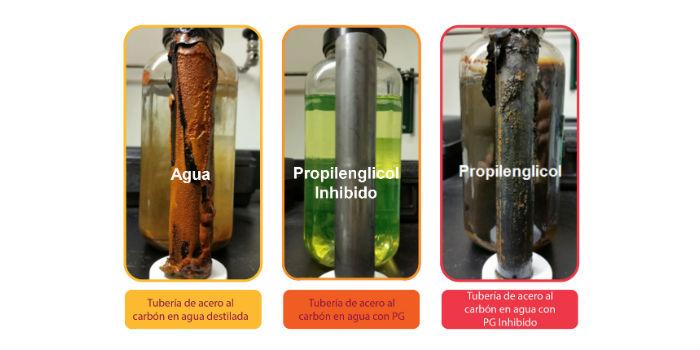
Uninhibited glycols may seem like an attractive alternative because of their ability to provide protection against freezing at a low price. However, this feature is not the only one that should be considered when choosing a heat transfer fluid. In fact, corrosion is a problem that cannot be ignored since it can present drawbacks such as:
1) Decrease heat transfer efficiency due to deposit accumulation
2) Generate waste that impedes the flow
3) Drilling the pipes, which can lead to contamination of the cooling fluid with the final product.
Corrosion will eventually lead to unscheduled shutdowns of your process, high maintenance costs, and a potential reduction in system life.
Why avoid using uninhibited glycols?
Due to a normal degradation process, glycols produce organic acids according to the reaction that when remaining in solution can lower the pH of the heat transfer fluid. By not containing corrosion inhibitors that allow these acids to be "buffered", and with it, protect the metal of the pipe, the corrosion rate of the system is much higher than even when pure water is used as a heat transfer fluid.
Inhibited glycols
The corrosion inhibitor packs used in the inhibited glycols are specially formulated to help prevent corrosion in two ways: First, by "passiveizing" the surface of the metal and thereby making it less prone to corrosion; and second, "buffering" the organic acids formed when the glycol degrades, avoiding a decrease in the pH of the fluid that can promote corrosion.
Glycols additionally have the characteristic of inhibiting microbial growth when found in concentrations greater than 25% v/v in the cooling system. This is because the osmotic pressure of the solution causes dehydration conditions in most microorganisms. However, at very low concentrations such as 1% v/v glycol can be a nutrient for microbial growth.
Depending on the final application, the use of Propylene glycol in food and beverage processing applications, as well as in supermarket refrigeration systems, or Ethylene Glycol for industrial refrigeration, is recommended. This is because Ethylene Glycol is a toxic glycol by ingestion. In companies where incidental contact with food may occur, inhibited glycol is offered with FDA (Food and Drug Administration) approval and, if necessary, with a dye for more effective identification of leaks.
The use of an inhibited glycol is the safest option in a secondary cooling system, with the following benefits:
1) Freeze protection
2) Corrosion protection
3) Protection against microbial growth (concentrations greater than 25% v/v)
4) Non-flammable
5) No smell
6) Non-toxic in the case of propylene glycol
The above as long as the following recommendations are taken into account: First, the dilution of the inhibited glycol should be done in a water that meets the minimum quality parameters; because impurities can increase corrosion, cause scale, reduce the effectiveness of inhibitors or impede the proper flow of heat transfer fluid. The recommended characteristics for dilution water are to have a concentration of chlorides and sulfates less than 25 ppm each and a hardness less than 100 ppm expressed as ppm of calcium carbonate.
Second, it is necessary to adequately monitor over time the parameters of the solution of inhibited glycols such as:
1) pH, acidic systems contribute to corrosion, a pH value between 8 and 10 is recommended
2) Concentration of scale promoters such as ppm of calcium carbonate
3) Appearance and smell, any drastic changes with respect to the initial conditions such as dark color, presence of two phases or sediments and strong odor may indicate contamination or degradation.
One measurement that can be made for more constant monitoring is to measure the refractive index of the solution which is directly related to the glycol concentration.
The use of inhibited glycol is the best solution to protect your refrigeration system in an economical and effective way; provided that the dilution water is of an appropriate quality and that the quality parameters of the cooling fluid are properly monitored.
References
1. Whitman, Bill, Johnson, Bill and Tomczyk, John. Application of refrigeration systems. Refrigeration and Air Conditioning Technology. New York: Cengage Learning, 2013.
2. The determination of acidic degradation products in aqueous ethylene glycol and propylene glycol solutions using ion chromatography. Rossiter Jr., Walter J., Brown, Paul W. and Godette, McClure. 1983, Solar Energy Materials, pp. 267-279.
3. A Study of the Inhibitory Concentrations of Glycerin-Sorbitol and Propylene Glycol-Sorbitol Combinations on the Growth of Microorganisms. Martin Barr, Linwood F. Tice. Philadelphia: Journal of Pharmaceutical Sciences.
* Diana Marcela Vásquez is a Technical Specialist in Thermal Exchange Fluids at Dow, you can write to the email [email protected]