
 Mechanical workshops create complex metal parts using thin sheets of similar or distinct metals along with diffusion bonding; compliant ventilation, heat exchangers, liquid/gas dispensing and other beneficial applications.
by PVA TePla America*
A unique additive manufacturing process is helping precision machine shops create metal parts with complex internal cooling ducts or channels to dispense layered liquids or gas before final machining.
The additive manufacturing process can be used to build a part from scratch with 1-2 mm thin sheets of metals and alloys. As with similar techniques, 3D modeling software is used to trace internal channels or sophisticated passages before the CO2 laser cutting of each layer.
The key to the process is diffusion bonding, which essentially fuses the combined layers under pressure and heat, without the need for brazing or other filler material. Traditional machining is then used to bring the outside of the part to its final shape.
With this technique, finished parts up to 900 mm (35.43") x 1250 mm (49.21") x 500 mm (19.69") can be constructed of stainless steel, titanium, zirconium, beryllium, high-alloy aluminum, Inconel and tungsten. The process can also be used to weld different metals such as copper to titanium, copper to aluminum, copper to tungsten and even molybdenum to aluminum.
For precision machine shops serving the medical, aerospace, semiconductor, and automotive industries, the technique provides a method for creating parts that are difficult, if not impossible, using traditional CNC equipment or less effective brass/welding techniques.
Sophisticated internal passages
For metal parts that require sophisticated internal channel geometries, whether with one input and one output, or none, there can be many twists and turns.
Examples include heat exchange applications, where channels are machined in aluminum to disperse heat by air or liquid cooling. Since the surface area of the cooling zone is a major factor in heat transfer, the more extensive the channels, the better.
Compliant cooling channels can also increase the efficiency and cycle times of plastic injection molds. These cooling passages follow the shape or profile of the mold core or cavity to perform a fast and uniform cooling process for injection and blow molding.
There are also applications with liquid and gas dispensing equipment. In semiconductor and microelectronics manufacturing, for example, sophisticated 'showerhead' gas distribution assemblies are used to dispense processing gases into a engraving semiconductor and deposition chambers. These dispensing heads often have multiple separate internal aisles.
Bonding layers of metals and alloys
Since traditional CNC cutting tools cannot be used for this purpose, an alternative that is already in use for elements such as showerhead assemblies is a similar additive process that varies in the way it joins the layers: with the brazing material.
Brazing is a metal bonding process in which two or more metal elements are joined together by melting and flowing a filler metal at the joint. The filler metal flows into the space between the layers through capillary action.
Although brazing has the ability to join similar or different metals with considerable strength, it also has major drawbacks when it comes to internal aisles.
Brazing can cause small "fillets" to form in aisles that obstruct flow and can even break during use. Little brazing material can create voids where liquid or gas and corrosion accumulate, especially in the presence of harsh chemicals such as those used in the semiconductor industry.
The result can be the delamination of the layers and the premature replacement of what can be extremely expensive pieces made of exotic materials.
Diffusion bonding, on the other hand, creates a superior bond without the need for any kind of filler material.
In the diffusion bonding process, high temperatures and pressures are applied to similar or different metals in a hot press, causing the atoms on the solid metal surfaces to intersperse and bond. Unlike traditional brazing techniques, the resulting bond exhibits the strength and thermal resistance of the base metals.
For the atoms of two solid and metallic surfaces to interpenetrate, they typically must be at about 50 to 70 percent of the absolute melting temperature of the materials. To achieve these temperatures, surfaces are heated in a furnace or by electrical resistance to temperatures as high as 1400°C.
For many years, this technique has been used to bond high-strength and refractory metals that are difficult or impossible to weld by other means. However, it was only through recent improvements in diffusion bonding presses that this new process has become even more attractive.
This includes improvements to single-cylinder hydraulic presses that required accessories to apply a constant, measurable amount of force, a key factor in the process.
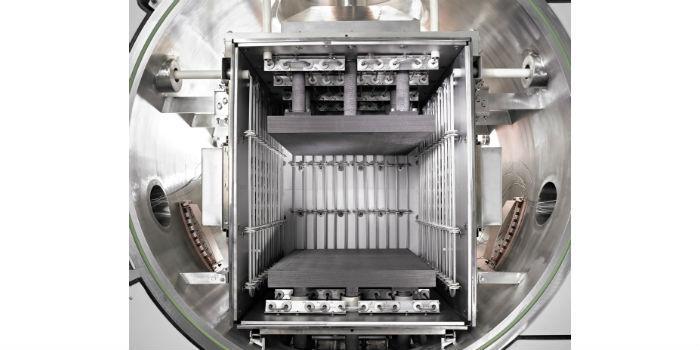
Today, leading manufacturers such as PVA TePla of Corona, California, offer multi-cylinder systems with large pressure plates that can accommodate a variety of parts. The largest, the company's MOV 853 HP can process parts up to 900 mm x 1250 mm with a pressing force of 4000 kN.
By controlling each cylinder independently, companies like PVA TePla can provide a press that provides extremely constant pressure across the entire surface. The MOV 853 comes with built-in pressure transducers along the bottom of the pressure plate that allow individual hydraulic cylinders to be adjusted to achieve superior pressure uniformity over large areas.
In addition to selling the equipment, PVA TePla can create diffusion-linked parts using this technique through toll processing services offered by its parent company in Germany.
How to join dissimilar materials
According to Walt Roloson, R&D engineering manager at PVA TePla, one of the most attractive aspects of the process is its ability not only to create the internal structures, but also to join layers of different metals. In this respect, there is no material restriction since all tool steels are available in bulk sheets.
"Customers often come to us with requests to bond aluminum with molybdenum or stainless steel," says Roloson. "We can do that with diffusion bonding."
The multi-layer design also enhances the conformal cooling of plastic injection molds made into 2-layer designs of steel tools and materials such as stainless steel (STAVAX).
"For the most efficient performance, compliant cooling channels must be adapted as precisely as possible to the outer shape of the mold," says Roloson. "The greater the number of layers joined together, the more precisely you can match the outer shape."
By improving cooling performance, molten resins can be injected at higher pressures to significantly increase cycle times by up to 40% while improving product quality.
Once the layers are joined together by diffusion bonding, Roloson says traditional machining techniques can be used to create the final external shape.
"Because of the molecular bonding of the layers, the final part often shows no interface lines or stretch marks. The interface of one material mixes with the other, and vice versa, even with different materials," says Roloson.
While this diffusion bonding additive manufacturing approach is for specialized applications, it can be a perfect complement to precision machine shops that already have in-house laser cutting and machining capabilities and are looking to diversify their offerings.
* For more information visit www.pvateplaamerica.com