
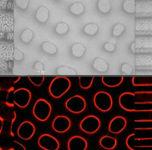
 United States. Researchers from the Massachusetts Institute of Technology (MIT) and Duke University created a flexible material that can change color or fluorescence, and its texture, at the same time, at will, and by remote control, simulating the activity of some mollusks that includes octopuses, squid and cuttlefish, which stand out for their ability to change the color and texture of their skin in seconds in order to blend in with the environment.
This material consists of a layer of electroactive elastomer that could be easily adapted to conventional manufacturing processes and that uses readily available materials. The material would serve as camouflage for the military sector, but could also be implemented for the production of coatings to combat the problem of biofouling on ship hulls.
Previous experiments have shown that even a brief change in the texture of a surface, usually smooth to allow for rapid movement, adopting for a while another rough one, can quickly remove more than 90 percent of the biological incrustations.
In its initial tests to demonstrate the concept, the material could be configured to respond with changes in both texture and fluorescence, or texture and color. In addition, while the current version may produce a limited range of colors, there is no reason why that breadth of palette cannot be increased.
The new synthetic material is a form of elastomer, a flexible polymer that can be widened. It modifies its fluorescence and texture at the same time, in response to a change in the voltage applied to it. This allows for very rapid change.
With information from www.invdes.com.mx