
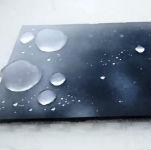
 United States. Scientists at the University of Rochester reported that they have used lasers to transform metals into extreme water repellents, or super-hydrophobic, without the need for temporary coatings.
Super-hydrophobic materials are desirable for a number of applications such as mold prevention, anti-icing, or even in sanitation uses. However, as Chunlei Guo of Rochester explains, most of today's hydrophobic materials are based on chemical coatings.
The scientists described a powerful and precise laser pattern technique that creates a complex model of micro- and nanoscale structures to give metals their new properties. This work builds on previous research by the team, in which a similar laser pattern technique was used that converted the metals to black. Guo claims that using this technique can create multifunctional surfaces that are not only super-hydrophobic but also optically highly absorbent.
Guo adds that one of the great advantages of the process is that "the structures created by our laser on metals are an intrinsic part of the surface of the material." That means it's not erased. And it's these patterns that make metals repel water.
As water bounces off super-hydrophobic surfaces, it also collects dust particles and carries them forward. To test this self-cleaning property, Guo and his team took the usual garbage from a vacuum cleaner and threw it on the treated surface. About half of the dust particles were removed with just three drops of water. It only took a dozen drops to leave the surface flawless. In addition, it is completely dry.
However, there are still challenges to be addressed before these applications can become a reality, Guo said. Currently, it takes an hour to patent a one-inch-by-one-inch metal sample, and scaling up this process would be necessary before it can be deployed in developing countries. Researchers are also studying ways to apply the technique to other, non-metallic, materials.