
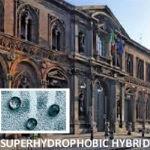
 International. The protection of stone monuments against deterioration has recently attracted a lot of attention from scientists. A precise analysis of the mechanisms of degradation of stones has led to the conclusion of the need for special protection against water condensation and salt formation.
For that reason, in one study, Italian researchers compared the strengthening effect of treatment-based nanoparticles with that exhibited by a commercial silane polymer. The surface properties of these types of smart coatings were investigated by different analytical techniques such as contact angle measurements and scanning electron microscopy (SEM) with energy-dispersive X-ray spectroscopy (EDS).
Aimed at evaluating the performance of the coating, a test of exposure to both UV aging and environmental air pollution was carried out. Diffuse reflectance spectroscopy (DRS) was used for the evaluation of CIELab colorimetric coordinates; while ion chromatography (IC) was adopted to evaluate the coating capacity to prevent the formation of salts (Cl-, NO3- and SO42-).
The study was published in the paper Smart hybrid coatings for natural stones conservation.