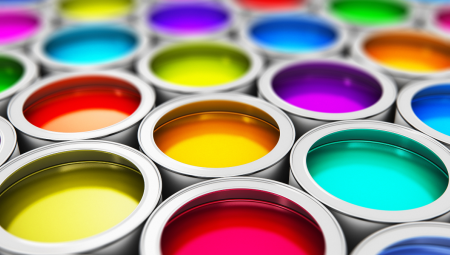

 United States. Researchers at the New Jersey Institute of Technology (NJIT) have developed a paint for use in coatings and packaging that changes color when exposed to high temperatures, giving a visual warning to people handling the material or equipment with the potential to malfunction, explode or cause burns if it overheats.
The technology was commissioned and funded by the U.S. Army's Weapons Research Engineering and Development Center (Ardec) in response to dangerous desert conditions during the war in Iraq, for example, where soldiers recorded near-munitions temperatures that had exceeded 190 times degrees F, well above casing design limits.
Zafar Iqbal's current research grew out of previous work at Honeywell, and then at Allied Corp., leading to a "smart coating" integrated with color-sensitive materials that indicates how long a substance has been exposed to temperatures high enough to compromise its functionality. The time-temperature device has been widely used by the World Health Organization, for example, on vaccine packaging labels.
"We essentially modified commercial paints and introduced nanotechnology-based concepts to adapt the trigger temperature," Iqbal explained, adding that his lab is beginning to develop paint-related inks that can be applied by inkjet printers.
The technology also has potentially broader applications, including temperature indicators for manufacturing machines, appliances and tools that signal they have become dangerously hot, or as a warning to firefighters of the intensity of a fire on the other side of a door lined with thermal paint. Several companies expressed preliminary interest. The patent is jointly owned by NJIT and the U.S. Army; NJIT plans to commercialize the technology.
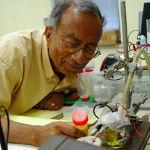
* In the picture, Zafar Iqbal, researcher of the new development.