
 Although at first the costs of processing nano polymers for paints restricted their use, today there are many applications that have been developed, even in Latin America.
by Vanesa Restrepo
A couple of years ago talking about nanotechnology implied thinking about high costs and impossible projects for Latin America, even in these same pages we refer to the little development that this type of applications had had in the region. But today the situation is different and great advances and solutions have been found with own compounds, derived from plants and materials typical of the area that reduce import costs.
News of new developments comes from different parts of the continent. In Colombia, for example, students from the Pontifical Bolivarian University experiment with applications with nano fibers derived from banana plants, in Brazil they develop photovoltaic nano cells to take advantage of solar energy and in Argentina they evaluate the properties of a new self-regenerating coating, just to name some of the most notorious examples.
From the beginning
Although the concept of "nanotechnology" is rather recent, its applications have been recorded cases such as the Cup of Lycurgus, a Roman decorative element of the fourth century BC, which today rests in the British Museum and is characterized by changing color (between red and green) according to the light it reflects. The cause of the effect is the presence of gold and silver nanoparticles in the glass with which the cup was made.
Already in the 40s the industry registered the first synthetic nano particles of carbon black and smoke silica. But it was only until 1974 that nanocomposites and nanoparticles began to be discussed, after the Japanese engineer Norio Taniguchi coined the term "nano-technology" in a paper published in the Proceeding of the International Conference of Production and Engineering.
Since then countless applications have been developed in different fields of knowledge including, of course, corrosion control and surface protection by coatings with special properties.
Today's Compounds
One of the people who has dedicated himself to studying nanotechnology is Julián Restrepo, PhD in Sustainable Chemistry from the Universitat Jaumet in Spain. Restrepo defines nano-composites as polymeric (thermoset, thermoplastic or elastomeric) or nanoscale inorganic materials; that is, its size is equivalent to one millionth of a meter (10-9).
During his most recent presentation on nanotechnology in the framework of Cubrecol Americas 2011, Restrepo explained that these nano compounds provide coatings with improved properties, such as:
* More resistance to wear (floors), scratching (cars) and abrasion (floors), impact and increase cracking resistance.
* Improve resistance to environmental impact outdoors and provide better performance against UV rays.
* Improve the ability to barrier gases and vapors.
* Increase adhesion.
* They provide more thermal stability, fire resistance and allow the formulation of fireproof paints.
* Add an antimicrobial, antiviral, fungicide, algicide, antimoho, antifungal effect,
Antibacterial and acaricidal.
* They allow the application of nano layers (layers of different materials at the nano scale that provide better protection to the surface).
* They provide better air quality, due to their purifying effect.
* Formulation of coatings that reduce allergy-related diseases and environmentally friendly paints.
* They allow the formulation of anti-odor photocatalytic paints.
* Improve anticorrosive properties.
* They allow the formulation of "stretchable paints" and with the ability to absorb thermal shocks.
* Improve resistance to water and fouling, allowing to reduce cycles
cleaning and maintenance.
* Reduce primer and coating processing.
* Applications in bio-fouling.
* Formulation of anti-graffiti paints, with resistance to dust, grease, oils, dirt.
These special characteristics of regeneration, dust resistance and antimicrobials mean that applications in the automotive and health sector (coatings for clean rooms and hospitals in general) have gained market in recent years.
An example is the Audi A9 vehicle, whose paint incorporates nano compounds that allow it to change color at the touch of a button and self-repair in case of scratches. Other brands such as BMW and Nissan have also developed nanotechnology paint for their vehicles, concentrating on self-cleaning and film regeneration in case of surface damage.
In the field of energy generation, nanotechnological coatings, explains Restrepo, also have a great future because today it has been possible to develop a series of coatings that when applied become photovoltaic nano cells that capture solar energy to recharge vehicle batteries, power the electrical system of a house or provide heat to the user of a special garment.
In England, a spray coating has already been developed that, when sprayed on metals on the roofs, allows energy to be generated to supply a building. "The material is based on nano structures of titanium oxide with a dye that mimics the photosynthesis of plants and lacks silicon, being cheaper than conventional solar panels," explains Julián Restrepo.
Pros and cons
Although adverse effects on humans or the environment are unknown until now, modern nanotech applications do have a couple of cons that arise from their physical properties that can limit the performance of a coating.
According to Piedad Gañán, dean of the School of Engineering of the Pontifical Bolivarian University (UPB), in Medellín, the synthesis process of nano polymers is key, since the homogeneity and regularity obtained during this process will control their physical and mechanical performance.
"The effectiveness in the development of nano materials is conditioned, without a doubt, to the effectiveness that is achieved to obtain the particles dispersed within the polymeric system," explains Gañán and adds that it is necessary to verify each stage of treatment of the nano compound to minimize the chances of having problems such as defects in the dispersion, load transmission, adhesion and alignment; defects in manufacturing processes, removal of solvents, alterations in additives, formation of agglomerates, among others.
The Dean also shared with the attendees of Cubrecol Americas some of the research projects in nanotechnology that she has been leading. There he explained that the main disadvantage of nano polymers used in the manufacture of coatings is their strong hydrophilic or hydrophobic character, as well as low adhesion and the formation of aggregates or agglomerations. However, these drawbacks can be remedied by treating the nano charge,
To highlight
Nano materials used today
According to the properties you want to add to a coating, the most suitable material will be selected. Currently on the market is a wide variety of polymers with nano-scale properties; among them the most outstanding are:
* Silver chloride with titanium dioxide: allows to formulate antibacterial and hygienic paints for restaurants, hotels and hospitals.
* Synthetic iron oxides: they absorb UV radiation and are transparent, so they are used for the protection of wood.
* Titanium dioxide: at the nanoscale, this pigment decomposes polluting organic particles, so it is used in self-cleaning paints that remove dirt with the help of rainwater. It also has antibacterial properties.
* Zinc sulfide: is resistant to impact.
* Silicon dioxide: improves scratch resistance and brings hardness to the film.
* Copper oxide: adds antimicrobial effect to the paint.
* Oxides of indium, antimony and tin: absorb infrared radiation and have anti-static effect.
* Zinc oxide: improves UV stability and resists microbial attacks.
* Aluminum oxide: improves the mechanical properties of the coating.
To highlight
Amazing effects
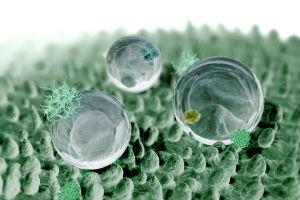
The Lotus effect is one of the greatest achievements of nanotechnology and its use has spread throughout the world. This effect results from nano-scale surface manipulation that forms a dirt-repellent surface. "The paint is applied with an extremely thin layer giving the hydrophobicity of the lotus leaf," explains the doctor in Sustainable Chemistry, Julián Restrepo.
But just a couple of months ago it was possible to develop a painting inspired by the properties of a carnivorous plant common in North America, which uses water as a liquid repellent by forming a kind of protective film with it.
This paint developed by scientists at Harvard University works at extreme temperatures and in high pressure, so it could be used in anti-fouling, anti-ice, biomedical applications and even in the industrial sector.