
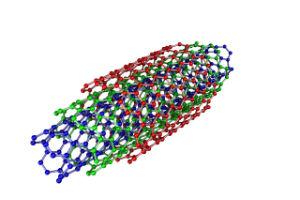
 The technology in paints has developed hundreds of applications that improve their characteristics, such as nanotechnology, which is a valid alternative and offers different advantages from the formulation.
by José Tomás Rojas*
Some time ago I took a nanotechnology course, online, with an institution called Coursera (es.coursera.org).
Surely many of you have heard of them, and have even participated in the courses they offer. If you do not know them, I invite you to visit them. It is a free education initiative, supported by prestigious universities, which offer high-level training, in the comfort of home, and in a very wide and varied range of knowledge. I'm sure they will take advantage of it and enjoy it a lot.
The nanotechnology course caught my attention, because in paintings, it is a term that has become fashionable, and I was interested in delving into the subject. Nanotechnology has even become a marketing element, and today nanomaterials are offered for sale , whose main value offer is that they are manufactured with this technology, without explaining in detail the advantage they offer, their mechanism of action, and what is the real impact they have on the performance of certain paints, beyond the fact of being manufactured with nanotechnology. Here I refer only to nanotechnology applied to the paint industry, because the area of application of this knowledge is certainly very extensive, particularly in the field of electronics.
When we talk about nanotechnology, we talk about size, to be specific, in the range of nanometers. One nanometer (nm), equals one billionth of a meter. To get an idea of what this measurement means, it can be commented that a typical germ can measure 1000 nm.
Now, beyond reviewing the issue of scale, it is more interesting to note what happens to the behavior of matter on those scales, in particular with optical properties, since this has a lot to do with the world of paint technology. To do this, nothing better than taking a look at what happens to gold, when reviewing its behavior, at different particle sizes:
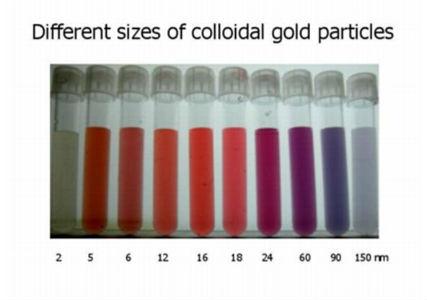
Notice, and this is something extremely interesting, that the colloidal scattering of gold changes its coloration, that is, its interaction with visible light, to the extent that its particle size changes, which indicates that the color of gold is not an absolute property, but relative to its particle size. If this is the case with gold, one may think that a similar exchange rate should be expected in other materials.
In paint technology, titanium dioxide is the material of greatest use, for its whiteness, and for its covering capacity, which is attributed to its high refractive index (2,496 in its Rutile form). However, today transparent titanium dioxide can be obtained when working at particle size in the nanometer range. This indicates a significant change in the optical behavior of titanium, and certainly not only in this aspect. In this size range, titanium even demonstrates catalytic activity, being used for example in paints that are able to eliminate bad odors from the environment, by degrading the molecules that cause that odor.
Another interesting material, and of massive use in paints, is calcium carbonate. This raw material has traditionally been used to lower costs in formulations, basically because its whiteness and covering are relatively poor, compared to titanium dioxide. Even, as a raw material it is classified in the group of fillers and loads, and as such, it is considered and valued.
However, today micronized carbonates are available with components in the range of nanometers, in their particle size distribution, which offer new possibilities, including functionality, in the paints where they are incorporated.
The main objective of micronized carbonates has been, above all, to use it as a partial substitute for titanium, without diminishing brightness. However, there are many other possibilities, such as the study of the variation of the optical properties of calcium carbonate, with the variation of particle size, in terms of whiteness and covering, which may open new fields for research. This implies, of course, giving a new approach, or rather, a new perspective, to the way we look at carbonate, to discover the great possibilities that this material can offer us.
* José Tomás Rojas. JTROJAS Pinturas, F.P. You can send your comments to the email [email protected]