
 The industry has evolved in the quest to perfect vehicle coatings with technologies that will last for many years.
by Duván Chaverra Agudelo
The automotive industry has a great responsibility when it comes to manufacturing its vehicles and that is that they have the ability to endure for many years working constantly without suffering significant damage to their entire infrastructure.
This includes not only electronic or mechanical behavior systems, but also one of the parts that must always remain well presented and preserved: paint.
In this article we conclude that coatings for the automotive industry have evolved significantly, to the point of ensuring that the application processes are very effective and technical and that their subsequent duration does not present major deterioration for many years.
However, the climate or the region where the vehicle is located remains a challenge for manufacturers of anticorrosive paints for vehicles that seek to minimize the damages caused by salt, snow, heat, water accumulation, among other factors.
Next, and with the help of two experts in the field, we will break down the reasons why we reached these initial conclusions, delving into the types of coatings for vehicles, parts that suffer the most wear, among other outstanding objects.
Luis Granes, sauereisen's international sales manager and member of the Association of Corrosion Engineers (Nace), highlights the technological progress made by automotive houses in terms of the development of parts, which has also meant a lower anti-orrosive index in this industry.
"At present, the use of new metal alloys in the manufacture of automobiles has radically decreased the corrosion process; Of course, the contact of dissimilar materials that are part of the body of the vehicle continue to generate cathodic corrosion, but it is currently minimal compared to previous years, "said the guest.
Regarding the steps to follow to execute for a correct application of anticorrosive coatings in vehicles, our guest from the powder coatings division of AkzoNobel in Mexico, Guillermo Navarro, laboratory technical manager, commented: "That the parts have a good pre-treatment, preferably zinc phosphate, and that in the application system it has a good conductivity, this in order that the powder is deposited in a good way, so that later the step of application of the powder coating is carried out".
For his part, Luis Granes, highlights the parts where more care is given to the application of the paint: "More than an anticorrosive film, the vehicles are put a coating system, asphalt-based, with other additives, which is applied at the bottom and that protects it from corrosion that is generated by the environmental conditions in the area, the stones and particles that remain on the road and that with the passage of the vehicle, jumps and impact it through the lower parts, exposing the metal to the corrosive conditions of the area where it is located".
Application and duration
With regard to the duration of the paint layer on a vehicle, certain technical aspects must be assessed, and as Luis Granes previously commented, it is necessary to analyze the environmental conditions in which the exposure of the vehicle to aggressive chemicals such as salt and saltpeter, as well as the water of the snowmelt process, they crowd under the vehicle and begin a corrosive process that progresses over the years.
In this regard, the engineer Guillermo Navarro emphasizes that "the vehicles must be controlled the thicknesses and do other quality tests such as adhesion analysis and curing tests".
The international sales manager of Sauereisen said in this regard that "for the lower parts of the body there are products of the elastomeric asphalt type that resist the extreme temperatures that are generated in the engine and in other components such as the exhaust and the catalytic converter, which protect these structures and parts against impact and chemical attack. The entire bottom of the cart is protected. Of course, frequent reapplications, as well as an ongoing maintenance process to these parts, helps minimize the impact."
As for the parts that pose the greatest risks of corrosion, both guests agreed that the chassis of a vehicle and all its components are the ones that suffer the most from this phenomenon. But there are also parts that are more complicated to protect than others. For example, the representative of AkzoNobel said that "there is more difficulty in the wheels, since first a metallic finish is applied and then a layer of acrylic transparent top coat ".
Meanwhile, Luis Granes stressed that "25 or 30 years ago, the exhaust system of the vehicle did not last even a year, due to the problem not only of corrosion by the cathode process, but by exposure to chemicals, saltpeter and water. But today, metal alloys, as well as the use of parts made of aluminum, allow a much longer and stronger service life to be given to parts."
But just as there are complicated parts to protect, failures in the application will surely bring serious consequences for vehicles, although this is already quite monitored by manufacturers through a department that thoroughly reviews each part. Events such as the detachment of the poorly installed product and the acceleration of the corrosive process of the vehicle can result from failures.
"The good performance of the painting is based on a good curing of the piece, as well as its pre-treatment; if this is not met, corrosion will appear more easily," Navarro said.
A single application
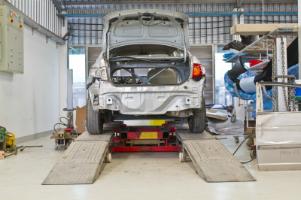
There are very few occasions in which a vehicle is applied an anticorrosive system after leaving the factory, this happens only in case of breakdown of the car as a result of a crash or repair, which shows the importance of the application of puncture in the assembly phase of the car.
To conclude, Luis Granes commented on this that "the coating for vehicles is already anticorrosive and anti-abrasive. The frequency of exposure of the vehicle to chemically and physically aggressive conditions is what will accelerate the deterioration process. Vehicles currently do not receive much corrosion protection after leaving the factory, except for the showers of these elastomeric products that are obtained in any mechanical workshop or in any gasoline pump, since the paint as such is not changed, unless you suffer an accident that requires a repair that includes new paint on the affected wall. And this is where things get complicated, because if the preparation of the surface is not correct, they will begin to generate problems that then have no other solution than to redo the process of painting the vehicle. "