
 We highlight the necessary conditions to correctly use a color measurement system and thus obtain the necessary results and without errors.
by Duván Chaverra Agudelo
In 2010, INPRA LATINA carried out an article (Spectrophotometers: choose precisely) that focused on knowing the different alternatives existing in portable spectrophotometers for paint analysis. At that time, this class of equipment was a novelty for its portability and ease of working in inaccessible areas or for its ability to process data instantly, among other features.
But not only the technical and specifications part is important. When measuring colors, there are many procedures that analysts must take into account to obtain correct results that avoid the generation of errors that can even mean higher costs. In this article we will delve into the recommendations to comply with a correct implementation of the device and the novelties of the system.
Everything to measure
Technology in any circumstance, product or system works ideally as long as it is well managed. The case of systems for color measurement is no different, as explained by Jonathan Tadeo Vázquez, Consultant Mexico of Konica Minolta, who initially stressed the importance of knowing the times and advances of the processes to perfectly execute the action of measuring color.
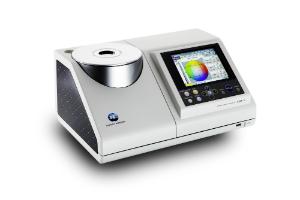
"For any application and especially with paints, it is necessary to take into account where in the process the color measurement will be taken, since it is not the same to make a formulation to match colors than to make comparisons between batches, or to control the concentrates," said the guest, who adds that "there are two types of colorimetric spectrophotometers: laptops and tabletops; to obtain greater accuracy and have the ability to make equalizations the table are ideal. To obtain differences between one batch and another, that is, to release product according to a standard, a laptop is useful for this."
We know that spectrophotometers have the ability to relate objective numerical data such as chroma, hue, saturation of a paint sample, but to find these results correctly it is necessary to obtain a product with good characteristics that allow it to be manipulated more easily.
We also consulted the expert on recommendations for choosing the most suitable color measurement system. Here, the most important thing is to be clear about what processes the system is specifically needed for and what kind of chemicals will be measured.
Jonathan Tadeo Vázquez commented on the following: "The main thing is always to know for what part of the process the instrument is required to control the color, and in addition, how far the application would be extended, that is, if we are also going to measure the color of enamels, solvents, oils or any other material involved with the paints. Therefore, we must be sure if we will only measure paint applied on a tongue, in a cell or in semi-transparent or translucent samples."
Technology
On the other hand, as explained by our guest, one of the most recent novelties known in this type of device has to do with the ease of wireless connection: "Some portable spectrophotometers have a bluetooth interface to be able to carry out full wireless measurements in production, so that the operators take the measurements without having to apply the paint on lenetas and do it directly in a cell or in a petridish. In the case of tabletop spectrophotometers, a special accessory is no longer necessary to take the measurement in a petridish, since the horizontal upper port can be used for measurement, contrary to previous spectrophotometers, where the reflectance port was vertical and it was complicated to take a liquid measurement, "explained Vásquez.
When asked about what are the mistakes that are most frequently made with the use of this equipment, he stressed that a very common mistake occurs when there are failures in the drying process.
This case applies to portable and tabletop spectrophotometers: "One of the main mistakes is not allowing the necessary time to dry the tongue and measure even with wet paint, which causes the integration sphere to be pigmented in various colors; this applies to portable and tabletop spectrophotometers," Vásquez explained.
It is clear then that the correct implementation of these systems is a chain that goes from theoretically knowing the equipment to following the recommendations of the manufacturers to achieve the ideal results and that allow to correctly qualify the application and formulation of the paints.
To highlight
Calibration of equipment
The company Equipos y Laboratorio de Colombia highlights on its website some simple methods to take into account so that spectrophotometers work correctly and therefore have a longer useful life from proper handling.
• Cleaning of the surface of the instrument.
• Cleaning of filters and light source (lamp and condenser).
• Verify electrical installations.
Recommendations for use and care of the equipment
a) Place the instrument in a place where it is not subject to vibrations, excessive heat, humidity or direct light.
(b) Protect the instrument from dust. Never touch optical surfaces such as lenses and filters. Follow the instructions given by the manufacturer for cleaning such components.
c) Allow the instrument to warm up before doing any procedure.
d) A periodic (weekly) check of the wavelength calibration should be carried out, when it is suspected that it has changed.
e) Check 0 and 100% T each time readings are to be made and when the wavelength varies.
f) Make sure the buckets are clean and free of scratches and fingerprints. This should be done every time it is going to be used.
To highlight
Pureba of operability
The steps to test the operability of the equipment are as follows:
a) Turn on the equipment and let it warm for at least 15 minutes (if the device is automatic, it will give a signal when it is ready to work).
b) The desired wavelength is selected (this depends on the sample to be read and the reagent used).
c) The absorbance or transmittance function is selected.
d) The apparatus is set to zero with distilled water. If the device to be used has both scales (absorbance and transmittance) the readings are adjusted to zero absorbance and 100% transmittance
using the thick and fine controls in vacuum.
(e) A standard of known concentration is read and the apparatus is adjusted to that concentration. If the device to be used does not have standard control, it is used to obtain the calibration factor, dividing the concentration of the standard by its reading.