
 The extreme conditions that aircraft must endure in terms of temperature and operating speed demand special characteristics of the coatings used in this industry.
by: Alejandra García Vélez
One of the topics that caused the most repercussion during the last edition of Cubrecol Americas was the one presented by Juan Manuel Álvarez, representative in Colombia of NACE (National Association corrosion Engeniering in Colombia), specialist in metal structures and composite materials and consultant in aeronautical and aerospace coatings.
Álvarez spoke precisely about coatings in the aeronautical industry, their importance, particularities and recommendations for their use. To begin with, the most important thing is to take into account the extreme conditions that coatings must withstand.
For example, these coatings are exposed to speeds ranging from 450 km / hour through 900 km / hour and up to 1500 km / hour, depending on whether it is an unpressurized aircraft, passenger powered by turbines or a combat aircraft. It can also be exposed to temperatures ranging between 7ºC and 45ºC on the runway and up to -20ºC in flight.
Another important factor to keep in mind is that coatings may be subject to abrasion due to particles that impact during flight, takeoff and landing, or to impacts by solids sent by other aircraft during hauling and taxiing, which are dragged by the power of the engines or turbines of those in front of them, Alvarez explained.
And he added that "due to the speeds of the aircraft, humidity generates a cutting effect on coatings, particularly in areas such as the leading edges of planes, stabilizers, radomes and spinners that is important to take into account."
In that sense, the adhesion conditions achieved by the coatings, as well as their texture are of vital importance in the aeronautical field. In his lecture, the expert addressed, among other topics, the ideal protection parameters, and the resistance characteristics of coatings.
On that point, he stressed that the chemical resistance of coatings to products such as fuels, hydraulic fluids, soot, detergents and other elements such as sludge and acid rain are fundamental.
The application
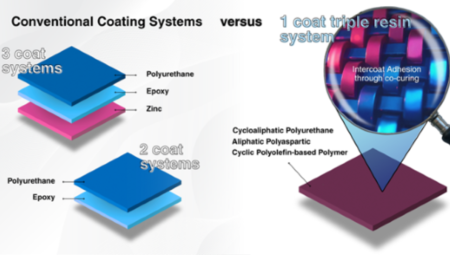
The types of coatings can be grouped into primers (or primers) and finishes. In the first, the bases are of different types according to the recommendations of the aircraft manufacturer through the maintenance manuals such as the CPCP (Corrosion Prevention & Control Program), the SPM (Standard Practice Manual)), and the SRM (Structural Repair Manual).
"The former are generally of the epoxy type, some of amides and others of amines or amino-amides. This dependency also originates in the area of the aircraft and type of surface. The finishes are mostly solvent-based polyurethane for exterior surfaces and water-based polyurethanes for indoor surfaces in passenger aircraft," said Álvarez.
It should be mentioned that the variety of products used depends on the type of surface, the configuration of the aircraft, exposure to chemical or climatic elements, the requirements of abrasion or impact on external surfaces, and aerodynamic or viscoelastic conditions required of coatings for behavioral effects with respect to aircraft surfaces.
As for the selection, elasticity, chemical resistance, abrasion resistance, impact resistance, resistance to hydraulic fluids, texture, hardness, adhesion and thickness, are the factors to be taken into account.
Subsequently, at the time of application, the percentage of solids, the mixing ratio, the application temperature, viscosity of the mixture, as well as the compliance of the times both in the mixture and in the drying, also the application equipment and the air quality of the pneumatic system must be taken into account. While in the conditions of application do not forget parameters such as temperature, relative humidity and dew point in the environment, number of hands and layers.
"Aeronautical coatings are increasingly important for their objective to fulfill such as protecting aircraft structures as a principle of corrosion control, which day after day from the environmental point of view is more aggressive for coatings, as well as that due to production effects and compliance with maintenance levels they require that coatings are not only very resistant but more durable and better behaved. in the face of aging," he concluded.
Cubrecol Americas
Finally, the guest of this edition highlighted the role and importance of Cubrecol Americas for the industry; "in events like this, both manufacturers of products and consumable materials are present, which can offer solutions or improvements for the work that is presented day by day. And, on the other hand, supports for the application and monitoring of coatings are presented, such as the variety of application and inspection equipment," he said.
And he added that "no less important is the presence of the exhibitors who share experiences and cases that provide the participants of the auditorium with ideas, procedures, conditions, specifications, norms and behaviors that are presented in each case. Within the context it can be evidenced that with events such as Cubrecol it is integrated into the industry and even academia and allows to observe the inertia and advances of technology both in products and services".