

In a market where technological progress is usually modest but important, coatings for the maritime and aerospace industries are opening a new episode.
By Andrea Ochoa Restrepo
One that is not only about protection, but also about efficiency, sustainability, and competition. The era of traditional paintings is progressing and a new generation of intelligent solutions is gaining relevance in the fields of aviation and navigation.
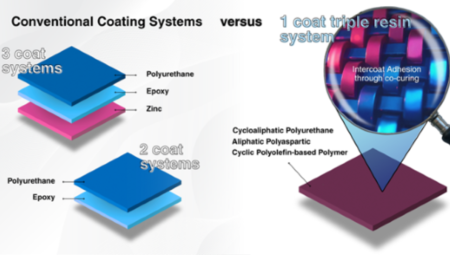
Corrosion, the eternal enemy – figuratively speaking – of marine structures, is no longer fought with the same weapons. Traditional epoxy formulations have come up with more sophisticated contenders: coatings that adapt to temperature, humidity and salinity, and that optimize the energy performance of boats by reducing friction with the water. The result is not only relief for operating accounts, but also an environmental statement: fewer emissions, more efficiency.
This technological advance is not isolated. Aviation, focused on safety and accuracy, also requires coatings that exceed the ability to withstand time. Today, ultra-light materials are being researched, with the potential to optimize aerodynamics, prevent ice build-up and, consequently, prolong the durability of aircraft. Each layer applied to a surface is now a strategic decision.
But beyond technical innovation, the great impetus for this transformation is cultural. The industry faces the obligation – no longer the option – to be sustainable. Regulatory and societal pressure is pushing towards solvent-free coatings, recycled materials, and bio-based options that meet more demanding standards without compromising performance.
Nanotechnology, in this context, emerges as a key ally. Solutions with nano-scale particles not only strengthen durability and strength, but also enable tailor-made responses. A coating is no longer a generic layer: it's a custom engineering tool.
The market is reconfiguring. Surfaces are no longer understood as a simple endpoint of industrial design, but as living spaces, capable of interacting with the environment, responding to its variables and providing strategic value. And that, in times of change, is not a minor detail.