
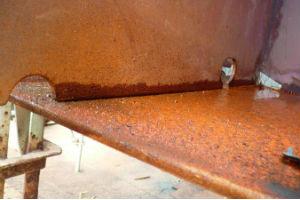
 The environment is a determining factor in the corrosion process of a structure, so it is vitally important to be clear about the concepts that generate it to react in time.
by Juan Manuel Álvarez*
From the cycle of articles or topics related to the assessment of corrosion we must also include everything that has to do with the environment in which the structures are located, analyzing this as an element of contribution to the concept of the reaction for the formation of corrosion and not as a working parameter of the material as a structure.
With regard to the affectation of materials due to the effect of corrosion, humidity, pH and temperature must be considered individually; since these variables are precisely those that are part of, or have a direct relationship, with chemical or electrochemical reactions in the formation of corrosion products.
Thus, this time we will deal with the way in which these "reactive" variables participate in the corrosion process.
Moisture itself is the electrolyte, which in electrochemistry is essential for reactions to occur. Electrochemistry is the field in which the interactivity of chemical reactions in the presence of electricity is required. In the electrolyte the ions (anions and cations or negatively and positively charged ions respectively) are formed that will be directed to the opposite charge electrode (anode or cathode) to carry out the oxidation reactions in the anode or the reduction reactions in the cathode.
The electrolyte allows the migration of matter in the form of anions to react with the metal anode for oxidation situations and thus lead to the formation of corrosion products; without the presence of the electrolyte, this process that causes the formation of most types of corrosion in existence would not be fulfilled, since most of these are electrochemical.
The humidity taken as an electrolyte can well be from the liquid state or by condensation of the relative humidity, which regulates or conditions the protection processes, since care must be taken with this concept for corrosion control purposes; this means that the electrolyte is basically an aqueous solution.
On the other hand, it is important to consider, for obvious reasons, that this moisture or electrolyte dissolves matter, which causes the electrolytes to have a specific pH that is measured as acidity or alkalinity, depending on the compound or molecules it dissolves. The pH determines the aggressiveness with which the reactions for the formation of corrosion are carried out through the reactivity that it presents with the application of the anode material, which is why the levels of acidity or alkalinity are important considerations that must be taken into account in the assessment of the environment.
Electrochemical kinetics is determined by the concentration of ions and by the mobility or displacement of these ions towards the oppositely charged electrodes, which makes the equivalence number of the dissolved element one of the variables to be considered in the electrochemical calculations that are made for the determination of the reaction rate in the generation of corrosion.
Another parameter that determines the reaction rate is temperature, since this is the energy that regulates in the reactions the solution for the formation of electrolytes, regulates the migration of ions to the electrodes, and regulates the reactivity in the electrodes for the formation of corrosion products, which is why temperature should be considered as the catalyst for corrosion.
The incidence of temperature is so important in the assessment of corrosion that in the different formulas and equations this kind of information is required, as for example, in the Nernst equation, in the Gibs energy directly or indirectly or dependently in the galvanic series, in the electrochemical series, at the Flade point, in the Pourbaix diagram and in many other corrosion-related events both for calculations, monitoring or laboratory research.
Therefore, humidity, pH and temperature as reactive variables that determine the environment in which the structures work must be measured and monitored to analyze the behavior of the different materials and the trend in the formation of corrosion.
To continue with this trend, the following article will deal with another topic related to the "valuation of corrosion", such as the "Working parameters (humidity, temperature, pH, pressure, mechanical work, vectors)", important analysis to take into account in the structural assessment that tends to the formation of corrosion products, and therefore to the formation and classification of the different types of corrosion, a vital issue in the selection of materials and in the monitoring for the determination of their useful life or durability.
As always I wish you a good aging and many successes in your work.
* Juan Manuel Álvarez is a Consulting Member of the technical committees of NACE International, Member of A.S.T.M, of ACICOR (Colombian Association of Corrosion Engineers), of ASCOR (Colombian Association of Corrosion and Protection), of ACOSEND (Colombian Association of Welding and Non-Destructive Testing), of ICONTEC (Colombian Institute of Technical Standards), of the technical committees of END, Welding, Coatings, Fuels and others. He is also a university professor and lecturer. You can write to the e-mail: [email protected]