
 Metal towers that correspond to communications usually suffer corrosion problems associated with the environment in which they are installed. However, sometimes coatings are only used to improve the appearance or identify the towers, forgetting the protection that these substances can provide.
 by: Quilyam Casallas*
The metal towers used as antennas are part of the great infrastructure that communications systems have. Because they are metal elements made of carbon steel, they are susceptible to corrosion attack, depending on the environmental conditions where they are installed. Thus, the estimated durability for a tower installed in coastal environments is totally different from the expectation in a tower located in a rural environment type C-1 or C-2 according to ISO 12944-2 standard. Even the situation of deterioration of these elements could be considered more critical when it is in the presence of industrial and marine coastal environments type C-5M or C-5I according to ISO standard.
When it is possible to identify and characterize the type of environment and the additional corrosive agents to which this metal infrastructure may be subjected, it is necessary to design coating schemes and intervention protocols, as well as application procedures that guarantee durability and stability of integrity over the years.
The most frequent mistake when making a maintenance project for this type of towers is to assume that the corrosion protection scheme may be unique and that it is applied indiscriminately to ferrous metal elements, regardless of the area of location or installation.
A particular case
One of the main problems we have in Colombia is that we do not have a corrosion map that allows us to geographically classify the areas, according to the characteristics defined by corrosive contaminants and intensity of attack, according to current international standards.
A characterized environment allows us to quantify thousandths of an inch in a unit of time in the case of metal losses attributable to a corrosion process.
The Colombian Association of Corrosion and Protection, ASCOR, is proposing the development of a study in conjunction with the corrosion research groups that currently exist in the faculties of metallurgical and materials engineering in some Colombian universities. This study, in which we also want to involve the productive sector affected by the phenomenon of corrosion, the scope is not only the characterization of environments and the quantification of metal mass losses due to corrosion, but also the alternatives of control schemes, basically based on protective coatings.
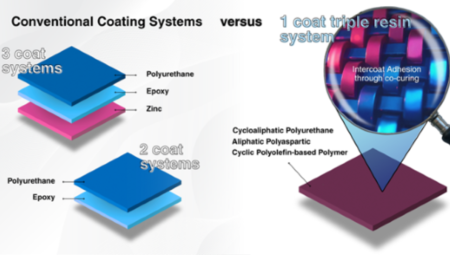
Currently these towers are protected with metallic coating schemes, complemented by epoxy type organic systems and an aliphatic urethane finish film. The thickness of dry film installed in most cases is similar, regardless of the geographical location which, as stated above, is one of the most important variables.
 Among the most commonly used metal coatings is hot-dip galvanizing film, which is nothing more than a high-purity zinc deposit installed on a ferrous metal substrate with a thickness of 80 microns, on average.
 Sometimes mistakes are made when thinking that the additional film of organic coatings should only be used to improve aspects such as aesthetics and comply with aeronautics standards, which define alternating colors in white and orange stripes.
Suggestions
The best protection alternatives are given with the use of galvanized surfaces protected according to the following scheme:
Surface preparation: Cleaning by manual methods according to SSPC-SP1 and SP2 technical standards.
Base Coating: Epoxy polyamide with a concentration of solids in volume greater than 60% at a thickness of 3 mils in dry film for environments of moderate aggressiveness.
Finishing coating: Aliphatic urethane enamel at a thickness of 2.5-3.0 mils in dry film.
Something very important to consider is the auditing and quality assurance during all stages of the process with qualified and certified personnel, attending to the technical standards that exist for this purpose.
* President of the National Corrosion Association of Colombia, Ascor. [email protected]