
Messrs. Inpra Latina
"Hello, My name is Carlos San Miguel and I am dedicated to giving painting services in Peru,
basically my work is aimed at housing works, but I have to do some work in a laboratory, and they ask me to apply a paint resistant to the solvents with which they clean the walls and that has a super smooth finish type automotive acrylic paint. I would like to know what kind of coating you could use, whether it can be an epoxy or something similar. Thank you, Carlos."
The answer is sent to us by the chemical engineer Julián A. Restrepo* of the Colombian company Invesa Sapolín.
The present work arises as a response to a concern of one of the readers of the magazine, in which it requires advice on the best paint system to use to paint a laboratory, which must be resistant to solvents with which they clean the walls and must have a "super smooth" finish, automotive acrylic paint type.
It is basically intended to make a small discussion about the different coating systems that can be used for industrial maintenance, or at least the most commonly used today in markets like ours.
Finally, an Epoxy-polyamide solvent-based system is recommended, for presenting the best cost-benefit balance for this particular application.
Types of systems
In this case we have that the client requires a glossy finish of high chemical resistance to solvents, and although it is said that it will be used in a laboratory, it is not specified if it is a chemical laboratory in which it will have contact with products for consumption, food or beverages. In addition, intrinsically, the coating is required to have good hardness, as well as a good level of gloss and surface smoothness, which can provide a greater "apparent hardness", making the surface more resistant to staining and to be allowed to be cleaned.
Being rigorous, when selecting a coating system for a specific application, it should be taken into account:
• Nature the substrate
• The State of the surface
• The required drying speed
• Color
• The Budget
• Chemical resistance
• Durability
• Environmental Regulation
In this case, we do not intend to be so rigorous and we will only discuss some of the previous points, which will allow us to make the choice of the best recommended system.
When we talk about industrial maintenance paints with good chemical resistance and that can provide a good level of brightness, we have the following options:
• Rubber-Chlorinated Paints
• Acrylic Paints
• Epoxy-polyamine paints
• Epoxy-polyamide paints
• Two-component polyurethane paints
Now we will briefly discuss each of its features, for the particular case:
Rubber-Chlorinated Paints: They are single-component paints, fast drying, high degree of impermeability, excellent adhesion and flexibility, resistant to abrasion, fresh and salt water, but have low retention of shine and are sensitive to aromatic and oxygenated solvents, fats and oils, and have a moderate resistance to alkalis and acids. Due to these latter reasons, they are ruled out in this case.
Acrylic Paints: Single-component paints, with excellent durability outdoors, excellent adhesion, with good retention of brightness and color; good resistance to water, acids and alkalis, fats and oils; but they have moderate resistance to ions, oxygen and heat, and are sensitive to solvents. Due to these latter reasons, they are ruled out in this case.
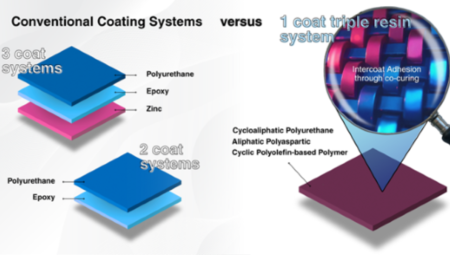
Epoxy-polyamine paints: Two-component paints: Component A is an epoxy paint and component B a polyamine catalyst that when mixed in the appropriate proportion, produce films of very good adhesion and flexibility, resistant to petroleum derivatives, weak acids, salts, alkalis, fats and oils, immersion in fresh or salt water and temperatures of 120°C dry and 70°C in immersion. In outdoor applications they entangle and discolor.
Epoxy-polyamide paints: Two-component paints: Component A is an epoxy paint and component B a polyamide catalyst that when mixed in the appropriate proportion, produce films of very good adhesion and flexibility, water resistant, resistant to petroleum derivatives, aromatic solvents, weak acids, salts, alkalis, fats and oils, immersion in fresh or salt water and temperatures of 120°C dry and 70°C immersion. In outdoor applications they entangle and discolor.
Two-component polyurethane paints: Two-component paints: Component A is a polysteric paint and component B an isocyanate catalyst that when mixed in the appropriate proportion, produce films of high hardness, resistant to moisture, abrasion and discoloration, with good resistance to acids and alkalis, excellent resistance to fats and oils; excellent outdoor resistance, so they do not discolor and have good retention of brightness and color.
That is, at this time we have that the three systems that can be useful in the application sought are: Epoxy Paints (either Epoxy-polyamine or polyamide) and Polyurethane systems.
It is important to note that, in this case, we are talking about the performance characteristics of conventional solvent-based systems. In any case, if it is desired or required to use "more environmentally friendly" systems or have regulation for the content of VOC's (volatile organic compounds, for its acronym in English), developments of these same systems such as high solid and water-based systems are currently on the market. which have practically the same performance characteristics of conventional systems, except, say, for aqueous systems, which tend to have a lower chemical resistance, in general, than solvent-based systems.
Discussion
Polyurethane systems are characterized by having an excellent balance between chemical resistance, abrasion resistance and durability in outdoor applications, but their cost tends to be a bit high.
The epoxy systems with each other (Epoxy-polyamine or polyamide) are very similar in their performance characteristics, and present an excellent cost-performance balance in indoor applications. Between both epoxy systems there are two basic differences: Epoxy-polyamine have a better chemical resistance than Epoxy-polyamide, but their performance is not very different in this regard; and in applications for surfaces in contact with food, beverages or consumer products, Epoxy-polyamide systems are preferred due to their lower toxicity than those based on Polyamine. In addition, in some markets, Epoxy-polyamine may have to be a little more expensive than Epoxy-polyamide, which makes the latter are, in many cases, the option to choose to paint plant surfaces of chemicals, food plants, laboratories and so on.
Final recommendation
Dear reader, if you do not have limitations in terms of the VOC content of the product, I suggest you use an Epoxy-polyamide system of two solvent-based components (conventional Epoxy-polyamide system), because I consider it is the system (of those we have available in Latin America), which presents the best balance between performance and cost. If this is the case, you may opt for a water-based Epoxy-polyamide system.
Although polyurethane systems also have excellent performance, because it is an indoor application, I believe that the Epoxy system is better.
You should keep in mind that (and very importantly), some paint manufacturers have epoxy systems that have a low brightness level, because they try to make their system employable for flooring applications. I suggest you identify a manufacturer in your country that offers a high-gloss epoxy system with good chemical resistance, which will make the surface have a smoother, "harder" and easier to clean finish. In this sense it is very important that you know the characteristics of the systems that are sold in your country and complement these comments with the advice of a technician from a paint company there, in order to better guide you about the application and obtain a guarantee in this regard.
It is very important to add that, the formulations of these systems are very specific to each manufacturer, so they can vary from company to company, so it is not enough, to perform some tests.
*I.Q. Research, Design and Development, Sapolín Paintings, Colombia, [email protected]