
 International. A color developed by the Egyptians thousands of years ago also has a modern application: pigment can increase energy efficiency by cooling roofs and walls, and it can also allow solar generation of electricity through windows.
Egyptian blue, derived from copper-calcium silicate, was routinely used in ancient depictions of gods and royalty. Previous studies have shown that when Egyptian blue absorbs visible light, it emits light in the near-infrared range. Now, a team led by researchers at the Department of Energy's Lawrence Berkeley National Laboratory (Berkeley Lab) has confirmed that pigment fluorescence may be 10 times stronger than previously thought.
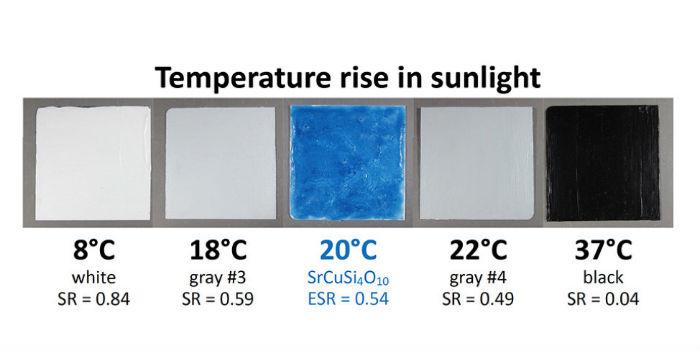
Researchers from the Berkeley lab, by measuring the temperature of surfaces coated in Egyptian blue and related compounds while exposed to sunlight, found that fluorescent blues can emit nearly 100 percent of the photons they absorb. The energy efficiency of the emission process is up to 70 percent (infrared photons carry less energy than visible photons).
The finding adds to ideas about which colors are most effective at cooling roofs and facades in sunny climates. Although white is the most conventional and effective option for keeping a building cool by reflecting sunlight and reducing energy use for air conditioning, building owners often require colors that are not white for aesthetic reasons. For example, bright white asphalt shingles are almost never used on sloping residential roofs.
Berkeley Lab researchers have already shown that fluorescent ruby red pigments can be an effective alternative to white; this view on Egyptian blue adds to the menu of cooling color options. In addition, they found that fluorescent green and black colors can be produced with yellow and orange pigments. The new findings were recently published in the Journal of Applied Physics.
In addition to its cooling potential for buildings, the fluorescence of Egyptian blue could also be useful for producing solar energy. Used in blue-tinted windows, photovoltaic cells at the edges can convert near-infrared fluorescent energy into electricity.
Substantial research over the years from Berkeley Lab's Heat Island group has found that reflective roofs and walls can cool buildings and cars. This reduces the need for air conditioning and mitigates the urban heat island effect. By reflecting the sun's rays back into space, these cool materials also release less heat into the atmosphere, thus cooling the planet and offsetting the warming effects of substantial amounts of greenhouse gas emissions.
This work was led by Paul Berdahl of the Heat Island Group as part of the Cool Walls project, supported by the California Energy Commission's Electric Program Investment Charges program.
Source: Lawrence Berkeley National Laboratory.