
 United States. Crude oil is sticky and frequently clogs the membranes of filters and other equipment used in the oil and gas industry. To address this problem, scientists at the U.S. Department of Energy's (DOE) Argonne National Laboratory developed a novel approach, which will extend the life of key industrial equipment.
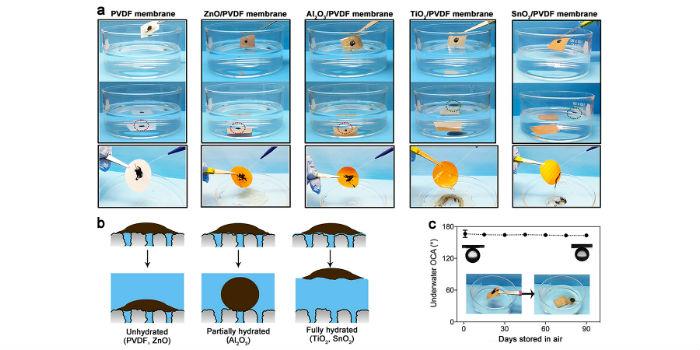
The new invention consists of a type of coating that produces thin films of molecules that reject oil and love water on the surface of filter membranes. These metal oxide molecules cling to any loose water atom while resisting the oil. For scientists, these twin properties are known as hydrophilicity and oleophobia.
"One of the best ways to clean up oily water is with membranes," said Seth Darling, Director of the Institute of Molecular Engineering at Argonne. "The problem is that the oil sticks to the membrane and clogs the holes until the membrane stops working. Today, if people have an oil-contaminated membrane, they replace it or try to clean it with harsh chemicals to remove the oil."
The scientists used a method called atomic layer deposition, which uses chemical vapors to deposit a very thin layer of metal oxide on all surfaces of the filter membrane. They experimented with using different metal oxides in commercial commercial polymer membranes to find which ones worked best. The team published the results in ACS Nano on August 14.
The deposition of the atomic layer itself is not new, but it has never been used in this way to modify membranes before, Darling said.
"It's kind of cutting edge," Darling said. "The coating is a few nanometers thick. If the coating were thicker, it would close the small pores. "What you want is a minimal change in the structure of the pores, but you want to change the chemistry of the substance lining those pores."
To create this layer in the past, people tried to attach the nanoparticles to a membrane by making them flow through them or by making them grow. But the particles tend to break off as water flows through those systems. The deposition of the atomic layer is different because the metal oxide film, in this case, forms strong chemical bonds with the polymer to which it is attached. In the process of deposition of the atomic layer, the membrane is exposed to a sequence of vapors that bind the molecules together, forming covalent bonds with the polymer.
"Some polymers bind more easily than others, and some repel oil, while others don't," Darling said of his group's process working with a variety of metal oxides. "At this point, we have a pretty clear idea of which ones work and why."
Tin oxide and titanium oxide formed the closest bonds with the water molecules, capturing them and layering them on the surface.
"When the oil comes into contact with the membrane, it will stay separate because it flows over the water layer," said Hao-Cheng Yang, a postdoctoral researcher working on the project.
Source: Argonne National Laboratory.